
Diving Rules for Protected Underwater Heritage Sites
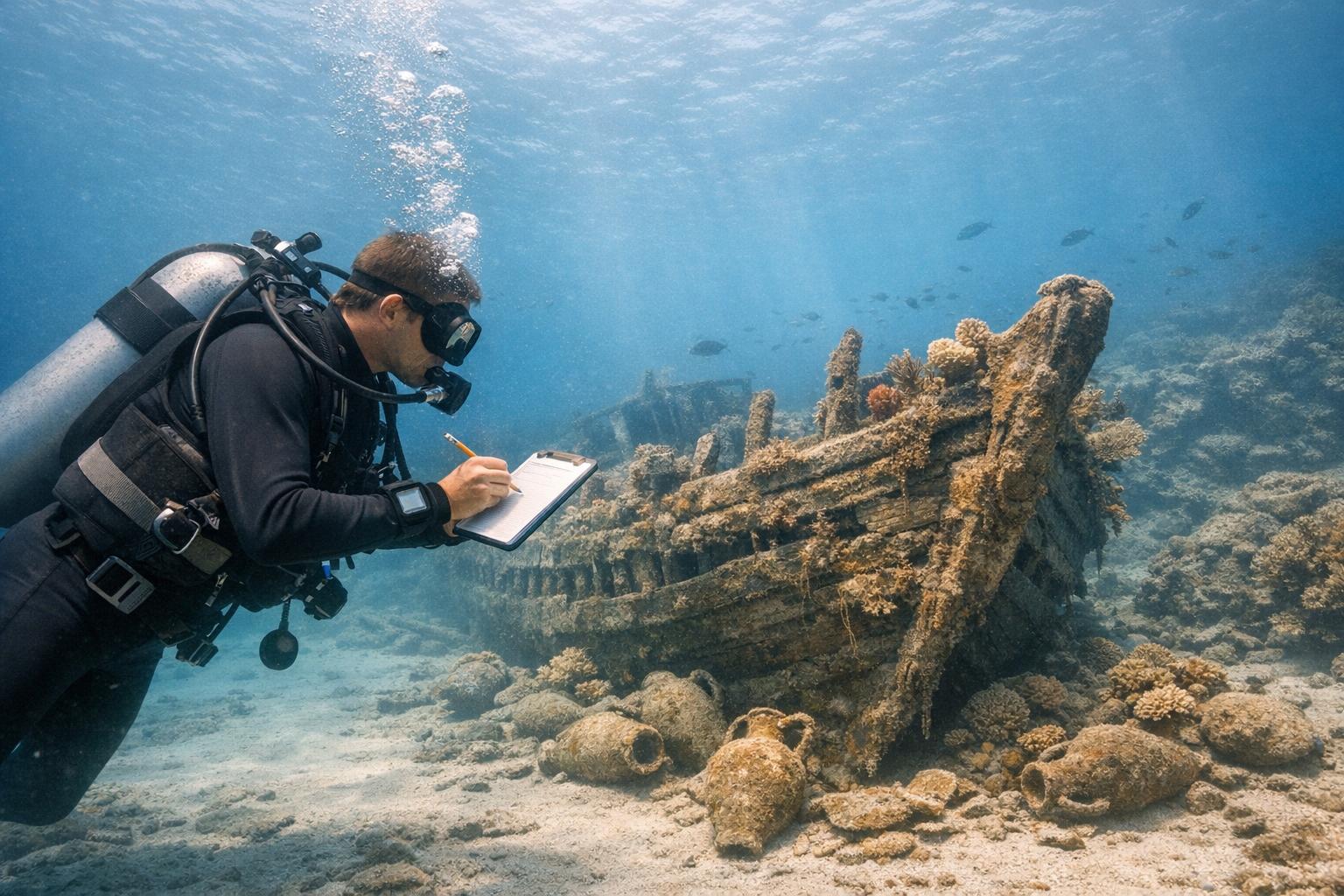
Diving at protected underwater heritage sites requires strict adherence to rules to preserve historical artifacts and ensure diver safety. These sites, like shipwrecks and sunken ruins, hold historical importance and may also pose risks, such as unexploded ordnance or structural hazards. To dive responsibly:
- Follow Regulations: Permits are needed for activities like touching or removing artifacts. Agencies like the U.S. Navy and NOAA enforce these rules, with fines reaching $100,000 per violation.
- Use Non-Disruptive Methods: Techniques like side-scan sonar, photogrammetry, and remote sensing allow documentation without disturbing the site.
- Report Discoveries: Document artifacts without moving them and notify the proper authorities, such as the State Historic Preservation Office or Naval History and Heritage Command.
- Prioritize Safety: Divers must have proper certifications, conduct risk assessments, and use appropriate gear, including backup systems and safety reserves.
Preserving these sites safeguards history and ecosystems while respecting their significance. Always dive with care and respect for the rules.
UNESCO Convention on the Protection of the Underwater Heritage

The UNESCO Convention on Underwater Cultural Heritage
For divers, the UNESCO Convention on the Protection of the Underwater Cultural Heritage is a cornerstone for preserving underwater heritage. Adopted on November 2, 2001, and coming into force in 2009, this treaty provides a global framework for identifying, researching, and safeguarding submerged cultural treasures. By September 2025, 80 countries had pledged to uphold its principles. For divers, understanding and adhering to this framework is essential to ensure proper preservation practices.
The Convention defines underwater heritage as any submerged traces of human existence that are over 100 years old and hold cultural, historical, or archaeological significance. However, it excludes active installations like pipelines or cables. This broad definition encompasses shipwrecks, sunken buildings, aircraft, prehistoric artifacts, and their surrounding archaeological contexts.
Keeping Heritage in Place
A key principle of the Convention is in situ preservation – keeping artifacts in their original underwater locations to maintain both the site’s integrity and its archaeological context.
"The preservation in situ of underwater cultural heritage shall be considered as the first option before allowing or engaging in any activities directed at this heritage."
Artifacts should only be recovered when doing so significantly enhances their protection or contributes to a deeper understanding of their historical importance, while also ensuring their long-term preservation. This approach stands in stark contrast to treasure hunting, which often scatters artifacts and erases critical historical records. The Convention’s Annex includes 36 rules that prioritize non-invasive techniques and survey methods over physical recovery.
No Commercial Use Allowed
Another pillar of the Convention is its strict prohibition of commercial exploitation. Heritage must not be treated as a commodity – artifacts cannot be traded or sold.
"The commercial exploitation of underwater cultural heritage for trade or speculation or its irretrievable dispersal is fundamentally incompatible with the protection and proper management of underwater cultural heritage."
This ban ensures that historical artifacts remain intact for scientific research and public education. Participating nations are required to impose penalties severe enough to deter illegal activities and strip violators of any financial gain. While the Convention encourages responsible, non-intrusive public access for educational and recreational purposes, any activities that could disturb a site require prior authorization from the appropriate authorities.
Main Diving Rules for Protected Sites
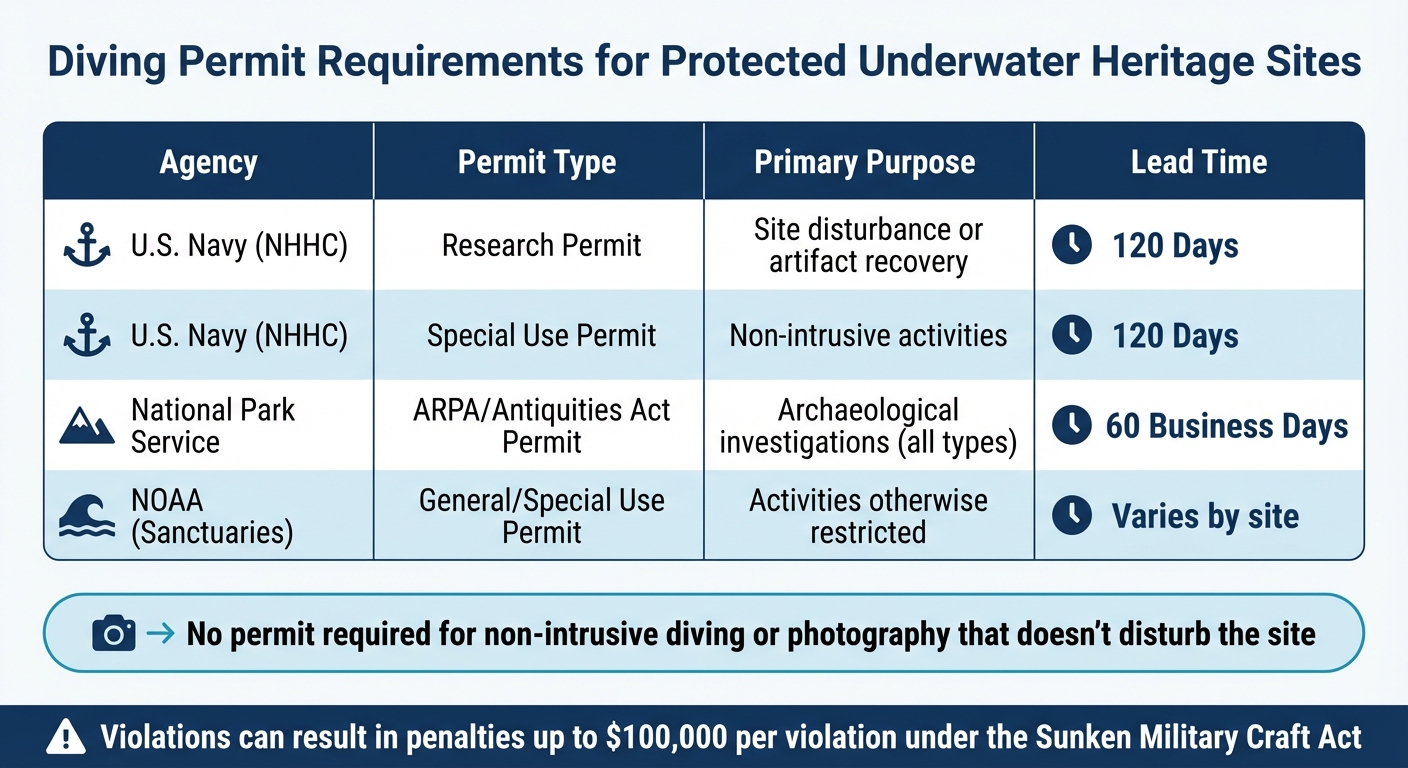
Diving Permit Requirements for Protected Underwater Heritage Sites
Diving at protected underwater heritage sites comes with specific rules designed to preserve these historical treasures. These regulations, rooted in international conventions and national laws, are essential for protecting underwater heritage. Whether you’re exploring a sunken warship or an ancient shipwreck, following these guidelines ensures compliance while safeguarding maritime history.
Planning and Permit Requirements
If you’re diving or taking photos without disturbing the site, no permit is required [2]. However, activities like touching, moving, or removing artifacts demand formal authorization from the relevant agency.
The type of permit you’ll need depends on the site and your planned activities. The U.S. Navy’s Naval History and Heritage Command (NHHC), which manages over 17,000 sunken ships and aircraft worldwide, offers two types of permits: Research Permits for archaeological work involving site disturbance or artifact recovery, and Special Use Permits for less intrusive activities. Applications for these permits must be submitted at least 120 days before your dive.
For sites within National Parks, you’ll need a Permit for Archeological Investigations from the National Park Service, even for non-invasive activities like photo-documentation. These applications are due at least 60 business days before your planned work. Diving in National Marine Sanctuaries, particularly high-protection sites like the USS Monitor, also requires permits for activities otherwise restricted by sanctuary regulations.
“U.S. Navy ship and aircraft wrecks are in principle to be left in place and undisturbed. At times, however, artifact removal or site disturbance is necessary or appropriate to protect a cultural resource, conduct scientific research, or provide for public education.” – U.S. Naval History and Heritage Command
Before formally applying for permits, contact the specific park or sanctuary office with a preliminary proposal to confirm the requirements. Your project’s Principal Investigator must meet the Secretary of the Interior’s Professional Qualification Standards, and you’ll need a written agreement from a museum or university to curate any recovered artifacts. Violating these regulations can lead to hefty penalties – up to $100,000 per violation under the Sunken Military Craft Act, with each day of non-compliance considered a separate offense [2].
| Agency | Permit Type | Primary Purpose | Lead Time |
|---|---|---|---|
| U.S. Navy (NHHC) | Research Permit | Site disturbance or artifact recovery | 120 Days |
| U.S. Navy (NHHC) | Special Use Permit | Non-intrusive activities | 120 Days |
| National Park Service | ARPA/Antiquities Act Permit | Archaeological investigations (all types) | 60 Business Days |
| NOAA (Sanctuaries) | General/Special Use Permit | Activities otherwise restricted | Varies by site |
Once permits are secured, divers must prioritize non-invasive methods to ensure the site remains undisturbed.
Using Non-Invasive Survey Techniques
When studying underwater heritage sites, non-invasive methods are the go-to choice for preserving site integrity. These techniques allow documentation and research without causing harm.
- Remote sensing tools: Tools like side-scan sonar, magnetometers, and sub-bottom profilers are ideal for mapping sites without physical contact. Side-scan sonar (600–1600 kHz) provides detailed images of the seabed. Magnetometers detect buried metal, while sub-bottom profilers uncover features beneath sediment with impressive resolution.
- Digital documentation: High-resolution photography, video, and photogrammetry enable the creation of detailed 3D models. When filming for photogrammetry, maintain a steady pace, ensuring at least 50% frame overlap [16]. Remove telemetry overlays like depth readings to avoid interference with software. Adding scale bars to key features ensures accurate measurements in your models.
- Diver-led techniques: Divers can conduct close inspections while following the principle of "take only photographs and leave only bubbles". Radial sweeps in 5-foot increments up to 50 feet help confirm anomalies. Hand-held detectors and sketches further document findings. For ROV use, maintain a steady altitude to avoid disturbing sediment with thruster wash.
Proper Artifact Handling and Reporting
After documenting a site, strict guidelines govern artifact handling and reporting. Artifacts should not be disturbed or removed unless absolutely necessary for preservation or research [2]. Federal and international policies emphasize leaving underwater heritage undisturbed.
"Take only photographs and leave only bubbles!" – Florida Department of State
If you come across an artifact during a dive, document its location and take photos without touching it. Report your discovery to the appropriate authorities. For state waters, contact the State Historic Preservation Office (SHPO). For federal waters, notify the Bureau of Ocean Energy Management (BOEM). Military wrecks must be reported to the Naval History and Heritage Command [2].
Artifacts include any part of a vessel or its contents – cargo, equipment, or personal items – that hold historical or archaeological significance. Sunken military vessels and aircraft remain the property of their flag nation indefinitely unless formally abandoned. U.S. regulations prohibit applying the "law of finds" to military crafts, whether domestic or foreign, within U.S. waters [2].
Before using excavation tools like air lifts or dredges, secure the necessary permits for archaeological research or recovery. Be cautious – protected sites, especially battlefields, may contain live ammunition. If you encounter unexploded ordnance (UXO), clear the area by 500 feet and alert authorities immediately.
These measures ensure the preservation of underwater heritage while keeping divers safe.
sbb-itb-289f5f2
Diver Safety and Organizational Duties
Diving at protected underwater heritage sites isn’t just about respecting preservation rules – it’s about following strict safety measures and understanding the responsibilities of everyone involved. From dive supervisors to individual divers, each person plays a part in ensuring safe practices while safeguarding these historical sites. At the heart of it all lies proper certification and thorough risk assessment.
Certification and Risk Assessment
Before diving at a heritage site, divers must carry the right certifications that match the complexity of the dive. At a minimum, an entry-level certification like the PADI Open Water Diver is required. This certification covers essential skills like buoyancy control, safety protocols, and fundamental dive principles. For more advanced dives or leadership roles, certifications such as Advanced Open Water, Divemaster, or Lead Diver are necessary.
When it comes to research-focused dives, the standards are even higher. Permits often require teams to include professionals with archaeological expertise to ensure responsible exploration, analysis, and reporting. Organizations like NOAA also enforce reciprocity agreements with partner agencies, ensuring all divers meet uniform safety and training standards.
Health checks are equally critical. Divers must complete a medical questionnaire, and those with conditions like heart or respiratory issues need a doctor’s approval before diving. Depth limits are strictly enforced – beginner divers stay above 60 feet, while recreational divers have a maximum depth limit of 130 feet. Additionally, organizations typically appoint a Unit Diving Supervisor (UDS) or Diving Safety Officer (DSO) to verify certifications and confirm liability coverage before granting access to sensitive sites.
"The only truly important thing about where you dive is that you have the training and experience for diving there, and that you have a dive buddy to go with you." – PADI
Site-specific risk assessments are essential. Heritage sites often pose unique dangers, like entanglement hazards from fishing nets, sharp edges on deteriorated structures, and overhead environments that prevent direct ascents. Environmental challenges such as "silt-outs" – where disturbed sediment clouds visibility – and the risk of structural collapse add to the complexity.
Once training and risks are addressed, the next step is ensuring divers are equipped with the right gear and emergency plans.
Equipment Requirements and Emergency Plans
Having the proper gear is fundamental to safe heritage diving. Standard equipment includes a valid certification card, a cold-water-rated regulator in good condition, a Buoyancy Control Device (BCD), and suitable exposure protection. For dives at heritage sites, additional tools like dual dive lights, cutting devices, and wreck reels are essential. A Signal Marker Buoy (SMB) is also required to alert surface vessels to your location, especially in busy or protected waters.
Gas management is critical. Divers should follow the "Rule of Thirds": one-third of the gas supply for the dive, one-third for the return, and one-third as a safety reserve. The "120 Rule" offers a quick way to calculate safe dive times – subtract the dive depth in feet from 120 to determine the maximum bottom time in minutes without needing decompression stops. Additionally, carrying a "save-a-dive" kit with spare parts like O-rings, fin straps, and mask straps can help resolve minor equipment issues.
Emergency planning is just as important as the dive itself. This includes having redundant systems like independent air sources and backup lights, as well as ensuring a clear and verifiable exit path for penetration dives. Dive supervisors must also confirm that all certifications and liability forms are in order.
"Although it can look safe to those uneducated in the risks, penetrating an overhead environment can rapidly turn into a potential death-trap through natural occurrences, unintended error or an equipment-related failure." – DIPNDIVE
While most activities at protected sites require permits, emergency actions to protect life, property, or the environment are generally exempt from immediate permit requirements. However, thorough pre-dive equipment checks – ideally completed at least two nights before the dive – are critical to ensuring everything is in working order.
Regulations by Country
Underwater heritage laws differ widely across the globe, with each country establishing its own rules to safeguard submerged historical and cultural sites. In the United States, the legal framework can be particularly intricate, as jurisdiction depends on whether a site lies within state waters, federal waters, or specially designated protected areas. Knowing these distinctions is crucial to ensure compliance and avoid hefty penalties.
Territorial Water Protections
In the U.S., the protection of underwater heritage is divided between state and federal jurisdictions, depending on the distance from shore. Most states manage shipwrecks within 3 nautical miles of their coastlines, but Florida and Texas extend their jurisdiction to 9 miles into the Gulf of Mexico. The Abandoned Shipwreck Act (ASA) grants the federal government ownership of abandoned shipwrecks embedded in state submerged lands, which are then managed by the respective states.
Beyond state waters, federal agencies take the lead. The Sunken Military Craft Act (SMCA) protects all U.S. sunken military vessels and aircraft globally, as well as foreign military craft within U.S. waters extending to the contiguous zone (24 nautical miles from shore). This law is strict – violators face civil penalties of up to $100,000 per violation, with each day of non-compliance treated as a separate offense. The Naval History and Heritage Command (NHHC) manages over 17,000 historic ship and aircraft wrecks under this authority.
Adding another layer, the National Marine Sanctuaries Act (NMSA) empowers NOAA to create specially protected areas with unique regulations. For instance, the Monitor National Marine Sanctuary was established to safeguard the wreck of the USS Monitor. Diving, anchoring, or salvage operations in this area are strictly prohibited without a NOAA permit. Similarly, the Florida Keys National Marine Sanctuary, covering 2,800 nautical square miles, enforces stringent "no-anchor" and "no-disturbance" rules at protected wreck sites.
| Law/Act | Jurisdiction | Primary Protection |
|---|---|---|
| Abandoned Shipwreck Act | State Waters (0–3 miles, or 0–9 miles in the Gulf) | Abandoned shipwrecks embedded in submerged lands |
| Sunken Military Craft Act | Federal (global for U.S. craft) | U.S. and foreign military shipwrecks and aircraft |
| National Marine Sanctuaries Act | Federal (sanctuary boundaries) | All cultural and natural resources in designated areas |
While non-intrusive activities like recreational diving or remote documentation don’t require federal permits under the SMCA, any action that disturbs, removes, or damages a site does. The NHHC makes this clear:
"Non-intrusive activities including diving on or remotely documenting sites do not require a permit or authorization from the NHHC".
However, the moment you touch, move, or excavate anything, you’re stepping into regulated territory.
In September 2024, the Department of the Interior introduced new regulations (89 FR 71160) requiring oil and gas companies operating on the Outer Continental Shelf to submit archaeological reports as part of their exploration or development plans. Effective October 3, 2024, this rule aims to identify and protect underwater heritage before offshore operations can cause damage.
Reporting Finds to Authorities
Understanding jurisdiction is only part of the equation – divers also need to know how to report any significant discoveries they make. If you come across an underwater artifact or an unknown wreck, there are legal obligations to follow. In most U.S. states, divers are strongly encouraged – or even required – to report discoveries rather than disturbing them. Unlike natural resources, cultural artifacts cannot regenerate once damaged or removed.
If you make a discovery, the first step is determining the appropriate authority to contact. For finds in state waters, reach out to the State Historic Preservation Office (SHPO) or the state’s Division of Historical Resources. For sunken military craft, contact the NHHC. If the site is within a National Marine Sanctuary, NOAA is the governing body. Discoveries in National Parks should be reported to the National Park Service Submerged Resources Center.
The reporting process is simple: document the location using GPS, take photographs without moving anything, and leave all artifacts undisturbed. Florida’s Division of Historical Resources sums it up with their guideline: "Take only photographs and leave only bubbles". Even isolated artifacts not linked to a shipwreck may be protected under state antiquities laws, so it’s always safest to report the find and let experts handle the assessment.
Florida enforces strict penalties for unauthorized excavation. Under the Florida Historical Resources Act (Chapter 267), intentionally disturbing underwater archaeological sites on state lands without written permission is classified as a third-degree felony. The Florida Department of State emphasizes:
"The diving public is encouraged to visit Florida’s unique historical and archaeological sites… However, these sites are protected by legislation that prohibits any disturbance or removal of objects".
For military wrecks, the SMCA leaves no room for interpretation regarding ownership. The law explicitly states:
"The ‘law of finds’ does not apply to any U.S. sunken military craft or any foreign sunken military craft in U.S. waters".
This means divers cannot claim ownership of artifacts from military wrecks, no matter how long they’ve been underwater. Sunken warships and military aircraft remain the property of their flag nation indefinitely unless formally abandoned.
Conclusion
Protected underwater heritage sites are irreplaceable. Once a shipwreck or archaeological artifact is damaged, there’s no way to restore it. Unlike coral reefs or fish populations, these treasures of the past don’t regenerate. As the Florida Department of State aptly states:
"Cultural resources do not grow back again once they are damaged or destroyed."
This core truth shapes the way we approach preservation, ensuring both the protection of history and the safety of divers on every expedition.
Preservation isn’t just about history – it’s also about safety. Strict rules help protect divers from dangers such as unexploded ordnance or hazardous materials that may still linger in old shipwrecks. Many of these wrecks are also war graves, marking the final resting places of sailors who deserve our respect and remembrance.
Every choice you make underwater matters. Practice neutral buoyancy to avoid disturbing fragile sites. Use mooring buoys instead of anchors to minimize damage. If you come across something unusual, document it with GPS coordinates and photos, and report it to the relevant authorities – like your State Historic Preservation Office, the Naval History and Heritage Command, or NOAA.
When you dive responsibly, you become a steward of history. The Department of the Navy oversees over 17,000 historic wrecks worldwide [2], and the North Carolina coast alone holds more than 2,000 vessels in what’s known as the "Graveyard of the Atlantic". These sites tell stories of maritime history and technological progress. By following preservation guidelines, you contribute to a legacy of exploration and conservation that honors both our past and the marine ecosystems that surround these underwater landmarks.
FAQs
Why do you need a permit to dive at protected underwater heritage sites?
Permits play a crucial role in safeguarding underwater heritage sites. They act as a protective measure, preventing the damage or unauthorized removal of artifacts, ensuring these historical treasures stay preserved for future generations. Beyond protection, permits also enable scientific research and conservation efforts, while discouraging any attempts at commercial exploitation.
Moreover, permits help enforce national and international laws aimed at preserving underwater heritage. They encourage responsible diving practices and uphold the historical and cultural importance of these remarkable sites.
What rules guide diving at underwater cultural heritage sites under UNESCO’s protections?
The 2001 UNESCO Convention on the Protection of Underwater Cultural Heritage emphasizes preserving underwater heritage while allowing responsible access. It mandates that heritage sites be preserved in situ – right where they are – whenever feasible and strictly prohibits commercial activities like treasure hunting. However, it does permit non-intrusive diving for educational and recreational purposes, as long as national authorities establish clear guidelines to ensure preservation.
In the United States, diving at protected sites usually requires obtaining a permit from agencies such as the State Historic Preservation Office. These permits come with specific rules, including maintaining neutral buoyancy to avoid disturbing the site, refraining from touching artifacts, and never removing materials. Divers are also encouraged to report any new findings or damage to sites, contributing to ongoing preservation efforts. Violating these regulations can result in fines or legal actions under U.S. laws designed to protect cultural heritage.
By respecting these guidelines, divers can enjoy exploring these incredible underwater sites while playing an active role in safeguarding them for generations to come.
What are the safety rules for diving at protected underwater heritage sites?
Diving at underwater heritage sites offers an extraordinary glimpse into history, but it comes with a responsibility to protect these delicate relics. To make sure both the diver and the site remain safe, here are some essential practices to keep in mind:
- Secure permissions and plan ahead: Confirm whether the site permits recreational diving and obtain any necessary permits well in advance.
- Maintain proper buoyancy: Use a buoyancy control device to stay steady in the water, keeping a safe distance of 3–5 feet from artifacts to avoid accidental contact.
- Stick to non-invasive equipment: Limit yourself to photography or video gear, steering clear of tools that could harm the site.
- Follow standard diving protocols: Always dive with a buddy, keep a close eye on your air supply, and complete all pre-dive safety checks.
- Respect the environment and rules: Observe site-specific regulations and avoid disrupting marine life or ecosystems.
By sticking to these practices, you’ll not only protect these historical treasures but also enjoy a safe and memorable diving experience.