
How Biodiversity Supports Adventure Travel

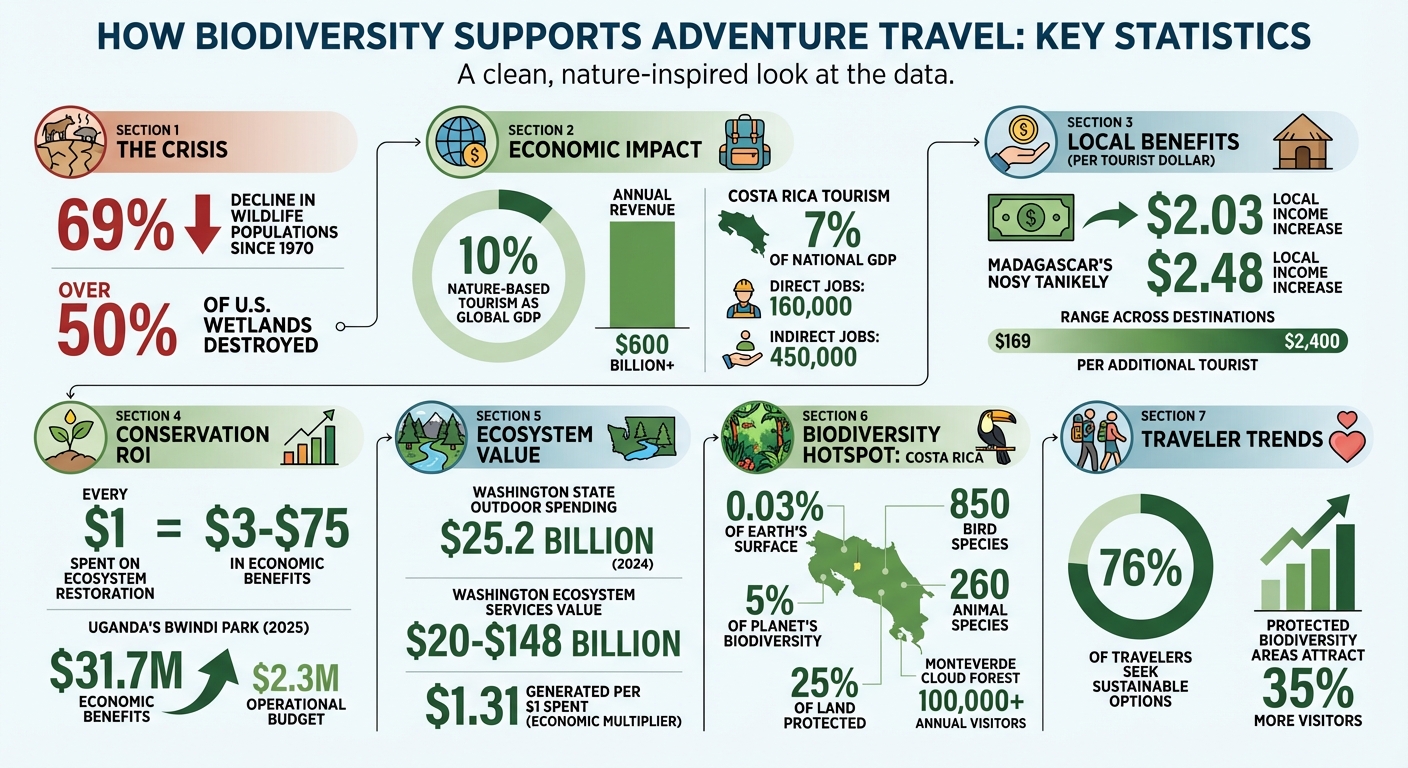
Biodiversity is the backbone of adventure travel, shaping the landscapes, wildlife, and ecosystems that make outdoor experiences unforgettable. It provides clean air, fresh water, and stable climates while offering unique opportunities to connect with nature. From Costa Rica’s thriving wildlife to Uganda’s gorilla trekking, destinations rich in biodiversity attract millions of travelers and generate significant economic benefits for local communities. However, with a 69% decline in wildlife populations since 1970, protecting biodiversity is critical to sustaining these experiences.
Key Points:
- Biodiversity Defined: Includes genetic, species, and ecosystem diversity, creating resilient environments for adventures.
- Tourism Impact: Nature-based tourism contributes 10% of global GDP, supports conservation, and boosts local economies.
- Health Benefits: Biodiverse areas reduce stress, as shown in a 2020 study on hikers in Idaho.
- Wildlife Tourism: Flagship species like jaguars and gorillas drive tourism, generating income for conservation and communities.
- Ecosystem Services: Forests, wetlands, and rivers provide essential services like water filtration, climate regulation, and soil stabilization.
By choosing eco-conscious travel options, supporting conservation efforts, and respecting natural habitats, travelers can help preserve biodiversity for future generations.
How Biodiversity Powers Adventure Travel: Key Statistics and Economic Impact
Wildlife Encounters and Their Impact on Adventure
There’s nothing quite like spotting a jaguar prowling through the jungle or catching a glimpse of the Resplendent Quetzal with its dazzling plumage. These moments leave a lasting impression and are a major draw for adventure seekers. Beyond the thrill, these wildlife experiences offer real psychological benefits, inspiring travelers to explore destinations where nature thrives.
Popular Destinations Known for Wildlife
Some places have earned their reputation for being wildlife havens. Take Costa Rica, for example. Despite covering just 0.03% of the Earth’s surface, it’s home to an impressive 5% of the planet’s biodiversity. With 25% of its land protected as national parks and wildlife refuges, the country provides habitats for 850 bird species and 260 animal species. This abundance of wildlife adds an extra layer of excitement to any adventure.
Corcovado National Park is a standout spot. National Geographic has called it "the most biologically intense place on earth." Here, visitors can see all four of Costa Rica’s monkey species in one location, along with jaguars and Baird’s tapirs. Over at Tortuguero National Park, boat tours along freshwater creeks reveal green sea turtles, manatees, and caimans. And then there’s the Monteverde Cloud Forest, often referred to as the "jewel in the crown" of Costa Rica’s reserves. It’s a magnet for those hoping to spot the Resplendent Quetzal while walking across hanging bridges that offer breathtaking views of the forest canopy.
In April 2023, tour guide Monica Leal led a group from Exodus Adventure Travels through Selvatura Park in Costa Rica. The highlight? A Resplendent Quetzal sighting during a trek across eight suspension bridges. Reflecting on the experience, Leal shared:
"When you’re in the forest, the most amazing words are ‘Look!’ ‘Where?’ ‘Gone.’"
Outside of Costa Rica, other destinations also shine. Bwindi Impenetrable National Park in Uganda is famous for its mountain gorilla trekking, which not only offers unforgettable experiences but also boosts local incomes by $2.03 for every tourist dollar spent. Similarly, Nosy Tanikely National Marine Park in Madagascar delivers even greater economic benefits, with each tourist dollar increasing local incomes by $2.48.
How Iconic Species Drive Tourism
While overall biodiversity is a draw, certain species – known as "flagship species" – can elevate a destination’s appeal. These charismatic animals, like jaguars, giant tortoises, and tropical birds, play a big role in shaping a destination’s identity. For instance, Costa Rica’s birdwatching tourism thrives not just on the sheer number of bird species but on the presence of rare and endemic ones like the Red-fronted Parrotlet in Monteverde.
The economic impact of nature-based tourism is massive. Globally, it’s the fastest-growing segment of the tourism industry, contributing about 10% of global GDP. In Costa Rica alone, tourism accounts for 7% of the national GDP and provides jobs for around 160,000 people directly and another 450,000 indirectly. The revenue generated supports wildlife conservation efforts and benefits local communities, with each additional tourist contributing between $169 and $2,400 to local incomes.
However, biodiversity alone isn’t enough to maximize tourism’s potential. Studies show that destinations with rich wildlife see the highest visitor engagement when paired with accessible infrastructure like ecolodges and well-maintained trails. Alejandra Echeverri Ochoa from Stanford University highlights the importance of this balance:
"The tourism sector should emphasize conserving species, because many people will pay to see wildlife and unspoiled places."
This creates a win-win cycle: tourism revenue funds conservation efforts like wildlife research and anti-poaching initiatives, while local communities, benefiting economically, are motivated to protect their natural surroundings. This approach allows countries to enjoy the benefits of their natural beauty without depleting their resources.
Ecosystem Services Supporting Outdoor Adventures
Biodiversity does more than inspire awe with its wildlife – it underpins the very systems that make outdoor adventures possible. Beyond the excitement of spotting animals in their natural habitats, healthy ecosystems provide the essential services that keep adventure travel safe and accessible. As described by the National Wildlife Federation, an ecosystem service is "any positive benefit that wildlife or ecosystems provide to people". Without these services, the trails we hike, the rivers we paddle, and even the air we breathe would be far less hospitable. These natural processes create the foundation for the outdoor experiences highlighted in the sections ahead.
Key Ecosystem Services for Adventure Travel
Ecosystems quietly work behind the scenes to create the conditions adventure travelers rely on. Plants clean the air, while bacteria and wetland vegetation filter water, ensuring the essentials for outdoor activities. Tree roots and vegetation stabilize the soil, reducing erosion and keeping trails and climbing routes intact. Wetlands and forests also play a critical role in managing floodwaters and regulating local climates, making trip planning more predictable and reliable.
The economic contributions of these natural systems are just as impressive. In Washington State alone, outdoor enthusiasts spent $25.2 billion in 2024, while the ecosystem services provided by local lands – like clean air, water, and flood prevention – were valued between $20 billion and $148 billion. For every dollar spent on outdoor recreation, an additional $1.31 of economic activity is generated.
The benefits extend to human health as well. Studies from Idaho reveal that biodiverse riparian zones – areas near rivers and streams – can significantly reduce stress. These areas serve as vital hubs for mental well-being, offering a direct connection between nature and human health.
Case Studies: Adventure Destinations Benefiting From Ecosystems
The impact of ecosystem services isn’t just theoretical – it’s evident in adventure destinations across the country. Washington State illustrates this perfectly. A 2025 report by Earth Economics and the Washington State Recreation and Conservation Office found that the state’s forests and waters generate up to $148 billion in ecosystem services, forming the backbone of its $25.2 billion outdoor recreation economy. Without the natural filtration provided by wetlands or the slope stabilization offered by forests, outdoor activities in the region would face greater risks.
The loss of these natural services has serious consequences. Over half of the wetlands in the contiguous United States have been destroyed, eliminating key systems for water filtration and flood control. As one study emphasized:
"The preservation of biodiversity… could better connect conservation goals with society by helping to protect both ecological integrity and resilience, as well as sociological and cultural services".
For travelers, supporting destinations that prioritize ecosystem protection is more than an ethical choice – it’s a way to ensure the longevity of their favorite activities. Simple actions, like sticking to marked trails in sensitive riparian zones, can prevent environmental degradation. Planning trips during off-peak times, such as mid-week, can also ease pressure on ecosystems and increase the chances of spotting wildlife. Additionally, backing wetland conservation efforts helps maintain the natural filtration systems that keep recreational waters clean.
sbb-itb-289f5f2
Sustainability Practices in Adventure Tourism
Eco-Tourism and Conservation Efforts
Nature-based tourism is a powerhouse industry, pulling in over $600 billion annually and accounting for 10% of global GDP. This sector thrives on the very ecosystems it showcases, making the protection of biodiversity not just an ethical priority but a business necessity. Enter "Nature Positive Tourism" – a transformative approach that goes beyond reducing harm to actively restoring and revitalizing ecosystems.
The financial case for conservation-focused tourism is hard to ignore. Every dollar spent on restoring ecosystems can yield economic benefits ranging from $3 to $75, thanks to the goods and services these ecosystems provide. Take Uganda’s Bwindi Impenetrable National Park as a prime example. In 2025, the park brought in $31.7 million in economic benefits for the surrounding region, dwarfing its operational budget of $2.3 million. A portion of this success comes from a revenue-sharing program that channels 20% of park entry fees and $10 from each gorilla permit into local projects. These initiatives help reduce human-wildlife conflicts and fund community infrastructure.
Costa Rica offers another success story with its Corredor Biológico Pájaro Campana (CBPC). This 129 km² biological corridor, established in 2007, connects cloud forests to coastal mangroves across private lands. Using the Three-wattled Bellbird as its emblem, the initiative incentivizes landowners to maintain forest connectivity. This corridor supports a thriving tourism hub, including the Monteverde Cloud Forest Reserve, which draws over 100,000 visitors annually. As David A. Fennell, a professor and author, explains:
"Ecotourism is travel with a primary interest in the natural history of a destination. It is a non-invasive and participatory form of nature-based tourism that is built around learning, sustainability (conservation and local participation/benefits), and ethical planning, development and management".
These examples highlight how eco-tourism not only preserves biodiversity but also fuels local economies, creating a win-win scenario for nature and communities alike.
How Tour Guides and Travelers Can Help
While industry-wide shifts are crucial, individual actions also play a big role in conservation efforts. Tourists contribute directly to local economies by paying entry fees and using local services. For instance, in areas like Nosy Tanikely National Park and South Luangwa National Park, tourism boosts local incomes significantly, with jobs tied to the industry supporting as much as 30% of the working-age population in some regions.
The World Bank emphasizes the transformative potential of this approach:
"Well-planned, well-managed nature-based tourism is a massive development opportunity. Money spent by tourists on activities, transportation, food, and accommodation ripple through local communities".
A great example is Lao PDR’s Nam Ha National Protected Area. In September 2025, trekking tourism combined with local homestays provided cash income to over 20 ethnic groups, linking their livelihoods directly to the conservation of the area’s biodiversity.
Travelers can also make an impact through citizen science. Platforms like eBird or even social media posts documenting wildlife sightings offer valuable data for researchers monitoring biodiversity trends. Meanwhile, tour guides play a vital role in minimizing environmental impact. By keeping groups on designated trails and using existing infrastructure, they help prevent habitat fragmentation while still allowing access to biodiverse areas. Protected areas that focus on biodiversity conservation attract nearly 35% more visitors than those managed for multiple uses, proving that conservation and tourism success can go hand in hand.
Conclusion
Key Takeaways
Biodiversity forms the backbone of adventure travel, enriching wildlife experiences and offering crucial ecosystem services like clean water, fresh air, and climate regulation. As E.O. Wilson aptly stated:
"Biodiversity is the very stuff of life".
Nature-based tourism now contributes a substantial 10% to global GDP. Preserving the ecological health of these destinations is crucial – not just because travelers instinctively connect with biodiversity through sights and sounds like vibrant landscapes or birdsong, which amplify their sense of wonder and well-being, but also because areas with richer biodiversity attract more visitors, generating greater economic opportunities for local communities.
The rise of conservation-focused vacations highlights a shift in traveler priorities, with 76% of people now actively seeking more sustainable ways to explore the world. These experiences often involve hands-on activities like habitat restoration, wildlife tracking, and ecosystem monitoring. The World Bank describes this trend as "a massive development opportunity" for regions that prioritize protecting their natural heritage.
These insights underline the need for responsible travel choices.
Encouraging Responsible Travel
Your decisions as a traveler can play a pivotal role in safeguarding these ecosystems. Opt for destinations that channel tourism revenue into conservation and support local communities. Seek out Indigenous-owned lodges or community-led tours to ensure that the financial benefits remain with those who care for the land.
Take steps to minimize your environmental impact. Stick to designated trails, maintain respectful distances from wildlife, and choose tour operators who actively contribute to conservation efforts. Some destinations now incorporate cutting-edge tools like environmental DNA analysis or acoustic sensors to monitor and protect biodiversity. As Nadine Lamberski from San Diego Zoo Wildlife Alliance explains:
"We are all part of a vast, interconnected system that links us – and our future. This inherent bond illuminates a renewed understanding of how conservation protects the vital biodiversity we rely on to thrive".
FAQs
How does biodiversity make adventure travel more exciting?
Biodiversity, which refers to the variety of life within a specific area, plays a huge part in shaping unforgettable adventure travel experiences. Regions teeming with wildlife, diverse habitats, and one-of-a-kind ecosystems offer more than just postcard-worthy views – they provide thrilling wildlife encounters and a profound sense of connection to the natural world. In the U.S., biodiverse areas like riparian zones, alpine meadows, and coastal dunes often boast the iconic landscapes and animal sightings that adventure seekers dream about.
But biodiversity isn’t just about beauty – it also contributes to well-being and strengthens local communities. Studies show that spending time in biodiverse environments can lower stress and improve mental health. On top of that, nature-based tourism can be a significant economic boost for local areas. By visiting these biodiverse destinations, travelers not only embark on incredible journeys but also play a role in protecting ecosystems and supporting the livelihoods of the people who call these places home.
How do flagship species attract adventure travelers?
Flagship species – think tigers, pandas, or whales – are the charismatic stars of conservation. Their allure pulls adventure travelers to protected areas, where they can experience the thrill of seeing these majestic creatures in their natural environments.
Beyond creating unforgettable travel moments, these animals play a critical role in raising awareness about conservation. They also help drive tourism dollars, which in turn support local communities and safeguard biodiversity. By encountering these extraordinary creatures, travelers not only deepen their bond with nature but also play a part in preserving it for future generations.
How can travelers help protect biodiversity while exploring nature?
Travelers can play an important role in protecting biodiversity by embracing low-impact recreation. This means sticking to designated trails, packing out all trash, and maintaining a safe distance from wildlife to avoid disturbing delicate habitats. Adhering to "Leave No Trace" principles, respecting seasonal closures, and steering clear of off-trail areas are simple actions that go a long way toward safeguarding ecosystems.
Another way to contribute is through financial support. Entrance fees, permits, and similar charges often fund essential conservation programs and the management of protected areas. Opting for eco-conscious tour operators or donating to organizations dedicated to conservation ensures that your travel spending directly aids biodiversity protection.
Lastly, think about becoming a citizen scientist or volunteering your time. Whether it’s reporting wildlife sightings, helping with habitat restoration, or sharing your observations with park officials, your efforts can provide valuable insights for conservation initiatives. By traveling thoughtfully and engaging in these practices, you can help protect the rich biodiversity that makes outdoor adventures so rewarding.