
Top 7 Off-Grid Power Systems for RVs
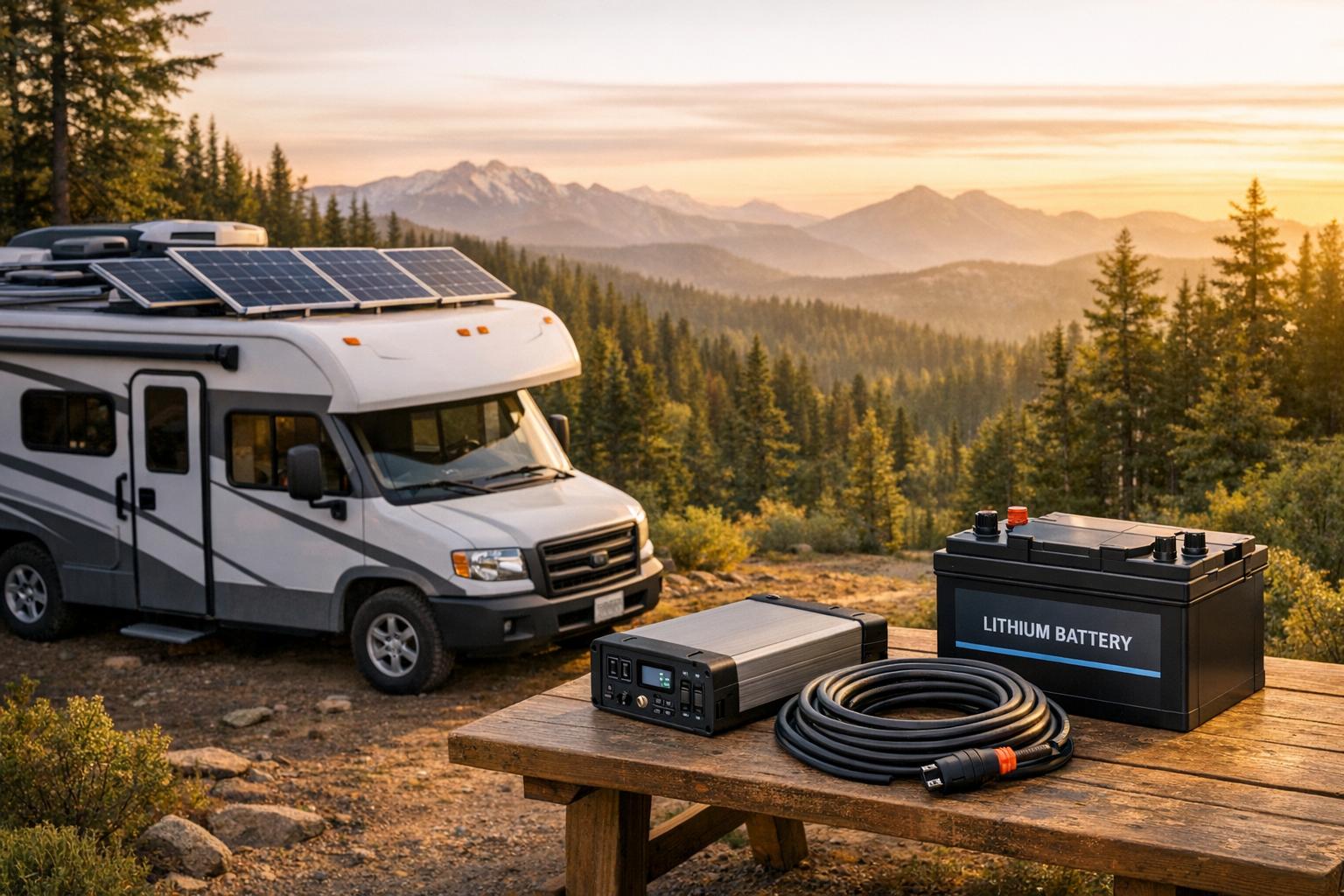
When you’re traveling off-grid in an RV, having a reliable power system is essential. This guide covers seven of the best off-grid power solutions for RV enthusiasts, ranging from portable solar generators to fully integrated setups. Whether you’re a weekend camper or a full-time traveler, these systems offer options for various power needs and budgets.
Key Highlights:
- Renogy 400W Solar Kit: Affordable, reliable, and ideal for roof-mounted setups. Generates 1,600–2,000Wh daily. Price: $409.99–$1,209.99.
- Jackery SolarSaga 200W with Explorer Series: Portable and lightweight; great for short trips. Price: $299.00–$699.00.
- Bluetti AC200Max: High-capacity portable power station with expandable battery options. Price: $1,199.00–$1,899.00.
- EcoFlow Solar Generator: Modular bifacial panels for efficient energy generation. Price: $249.00–$659.00.
- Goal Zero Yeti PRO 4000: Premium system with flexible charging and high power output. Price: $2,039.89–$3,399.95.
- ECO-WORTHY 200W Solar Kit: Budget-friendly option for basic needs. Price: $189.99–$555.34.
- Battle Born Batteries & RICH Solar Panels: Scalable, long-lasting lithium battery setup. Price: $10,000–$15,000 for a complete system.
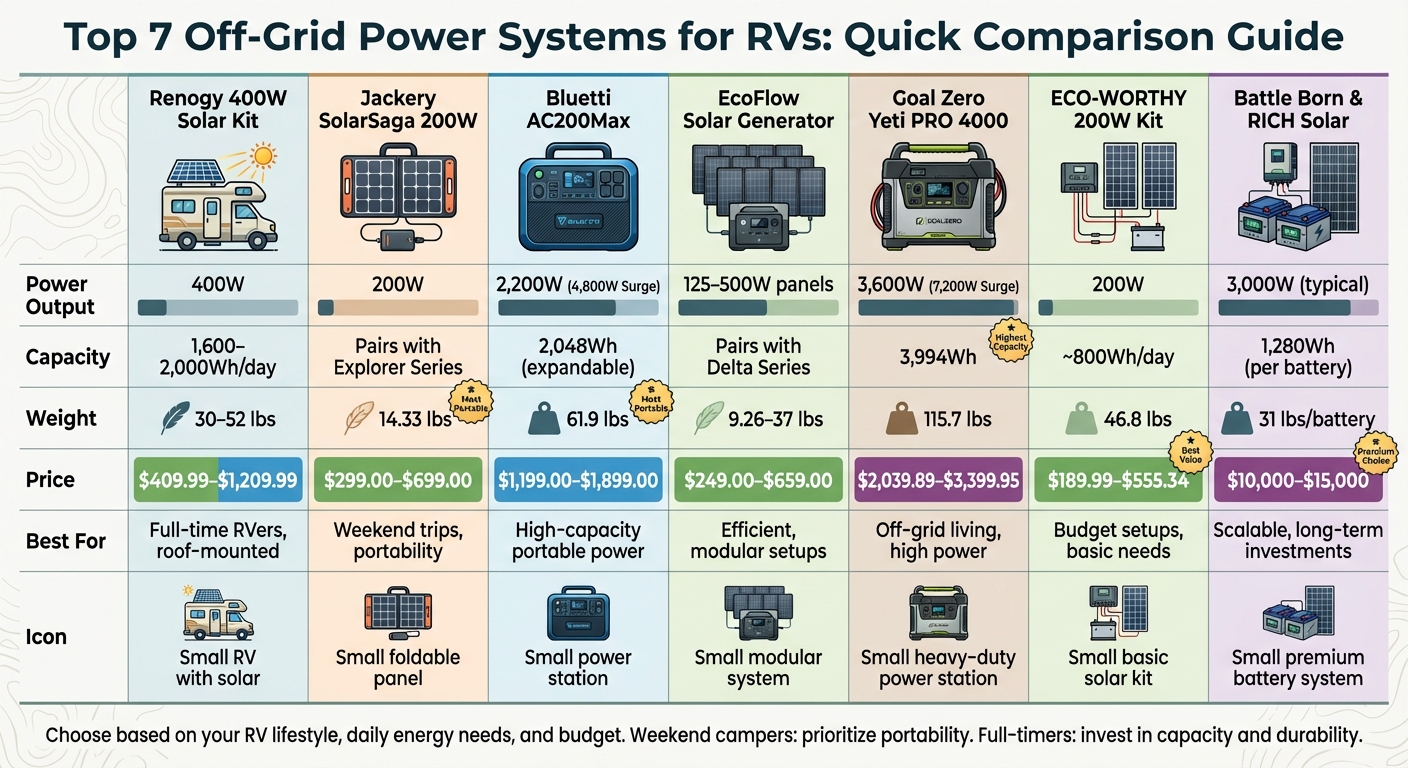
Quick Comparison
| System | Power Output (W) | Capacity (Wh) | Weight (lbs) | Price Range (USD) | Best For |
|---|---|---|---|---|---|
| Renogy 400W Solar Kit | 400W | 1,600–2,000Wh/day | 30–52 lbs | $409.99–$1,209.99 | Full-time RVers, roof-mounted |
| Jackery SolarSaga 200W | 200W | Pairs with Explorer | 14.33 lbs | $299.00–$699.00 | Weekend trips, portability |
| Bluetti AC200Max | 2,200W (4,800W Surge) | 2,048Wh (expandable) | 61.9 lbs | $1,199.00–$1,899.00 | High-capacity portable power |
| EcoFlow Solar Generator | 125–500W panels | Pairs with Delta | 9.26–37 lbs | $249.00–$659.00 | Efficient, modular setups |
| Goal Zero Yeti PRO 4000 | 3,600W (7,200W Surge) | 3,994Wh | 115.7 lbs | $2,039.89–$3,399.95 | Off-grid living, high power |
| ECO-WORTHY 200W Solar Kit | 200W | ~800Wh/day | 46.8 lbs | $189.99–$555.34 | Budget setups, basic needs |
| Battle Born & RICH Solar | 3,000W (typical) | 1,280Wh (per battery) | 31 lbs/batt. | $10,000–$15,000 | Scalable, long-term investments |
Each system has its strengths, from affordability to high power output. Choose based on your RV lifestyle, daily energy needs, and budget.
RV Off-Grid Power Systems Comparison: Specs, Prices & Best Use Cases
My FULL RV Solar Power System | Products I Use Off Grid Camping
1. Renogy 400W All-in-One Solar Kit
The Renogy 400W Solar Kit is a dependable solution for RV enthusiasts who want to enjoy off-grid camping without the hum of a generator. This kit comes equipped with four 100W monocrystalline solar panels, a 30A charge controller, mounting hardware, and all necessary cabling. Let’s break down its performance highlights.
Power Output (W)
With four 100W panels, this kit provides a solid 400W output, ensuring ample power for off-grid needs. The panels feature high-efficiency N-type solar cells, boasting a conversion efficiency of up to 25%.
Capacity (Wh)
In optimal conditions – about 4–5 hours of peak sunlight – it generates between 1,600 and 2,000Wh daily. That’s enough to power a typical 12V RV refrigerator (which generally consumes 50–80W per hour), charge multiple devices, run LED lights, and keep a WiFi router operational throughout the day.
Portability (Weight in lbs)
The kit is available in two configurations to suit different needs. The rigid panel version, designed for permanent roof mounting, weighs 52 lbs in total (approximately 13.0 lbs per panel) and includes pre-drilled holes and Z-brackets for installation. For those seeking greater flexibility, the 400W Lightweight Portable Solar Suitcase offers a foldable design with integrated kickstands and weighs just 30.2 lbs.
Price Range (USD)
The Starter RV Kit is priced between $409.99 and $469.99, making it an affordable option for off-grid solar power. For added portability, the suitcase version ranges from $499.99 to $539.99. If you’re looking for more advanced features, customizable kits with upgraded MPPT controllers are available and priced between $799.99 and $1,209.99.
2. Jackery SolarSaga 200W Portable Solar Panels with Explorer Series

The Jackery SolarSaga 200W is a portable solar panel designed for RV enthusiasts who want the flexibility of a mobile setup rather than a fixed roof installation. This foldable, briefcase-style panel pairs seamlessly with Jackery’s Explorer portable power stations. Thanks to its bifacial design, it captures not only direct sunlight but also reflected light from the ground, delivering a higher energy output compared to standard single-sided panels. Here’s a closer look at its key features.
Power Output (W)
The SolarSaga 200W boasts a peak output of 200 watts, utilizing Topcon monocrystalline cells with an impressive 25% conversion efficiency – outperforming the 20–22% range typical of many portable panels. It’s reliable even on partly cloudy days, and the SolarTarget feature allows users to adjust the panel’s angle throughout the day for optimal sun exposure. This setup ensures better off-grid performance by maximizing both direct and reflected sunlight. For added convenience, the panel includes built-in USB-A (12W) and USB-C (15W) ports, enabling direct device charging without the need for a power station.
Capacity (Wh)
While the SolarSaga 200W doesn’t store energy itself, it’s designed to recharge Jackery’s Explorer Series power stations efficiently. For example, pairing six SolarSaga 200W panels with the Explorer 2000 Plus (which has a capacity of 2,042.8Wh) can fully charge the power station in under 2.5 hours. Other popular combinations include the Explorer 1000 v2 (1,070Wh capacity) and the Explorer 1000 Plus, which starts with a 1,264Wh capacity but can expand up to 5kWh.
Portability (Weight in lbs)
Weighing just 14.33 lbs, the SolarSaga 200W is significantly lighter than the 22.05 lbs of the SolarSaga 500X. Its foldable design, complete with magnetic handles, collapses into a compact size that fits easily in RV compartments or truck beds. With an IP68 waterproof and dustproof rating, it’s built to withstand rain, snow, and dust, and it operates reliably in temperatures ranging from 14°F to 149°F.
Price Range (USD)
The SolarSaga 200W typically retails for $699.00, although it often goes on sale for as low as $299.00 on Jackery’s official website. On Amazon, the current price is $549.99. While the cost per watt is higher than that of fixed roof-mounted systems, its portability and versatility make it a smart choice for RVers who park in shaded areas and need to reposition their panels for maximum sun exposure without altering their vehicle permanently. Customer reviews reflect its quality, with a 4.74 out of 5-star rating from 154 reviews on Jackery’s site and a 4.8 out of 5-star rating from over 1,350 reviews on Amazon.
3. Bluetti AC200Max Portable Power Station

The Bluetti AC200Max is a portable power station designed with RV enthusiasts in mind. It features a built-in NEMA TT-30 (30A) outlet, allowing you to plug in your RV’s shore power cord directly – offering a quieter alternative to gas generators. Let’s take a closer look at its power output, capacity, portability, and pricing.
Power Output
The AC200Max provides 2,200W of continuous power and can handle surges up to 4,800W, thanks to its pure sine wave inverter. It also includes a high-current 12V/30A DC port, which is perfect for charging RV house batteries or running power-hungry 12V devices like air compressors. The pure sine wave output ensures safe operation for sensitive electronics such as laptops, CPAP machines, and entertainment systems.
Capacity
This power station is equipped with a 2,048Wh LiFePO4 battery, which is rated for over 3,500 cycles before dropping to 80% capacity. For those needing more power, the system can expand to 8,192Wh by adding two B300 battery modules. With its base capacity, the AC200Max can power a 150W RV refrigerator for 10–15 hours or a 600W microwave for about 2.7 hours. The charging system is flexible, supporting up to 900W of solar input and 500W from an AC wall outlet simultaneously. This dual input allows for a combined charging rate of 1,400W, fully recharging the unit in roughly 2 to 2.5 hours.
Portability
At 61.9 lbs and measuring 16.5 x 11.0 x 15.2 inches, the AC200Max is compact enough to fit into most RV storage compartments. However, its weight and the absence of wheels mean it’s best handled by two people or with the help of a cart. Many RV users prefer to set it up in a semi-permanent spot and monitor its performance remotely via the BLUETTI App, which connects through Bluetooth.
Price Range
The Bluetti AC200Max is priced between $1,199.00 and $1,899.00. It boasts an impressive 4.9 out of 5-star rating from 180 reviews on Bluetti’s official website. Customers frequently praise its dedicated 30A RV outlet and user-friendly touchscreen interface. However, some note that the touchscreen can be hard to read in bright sunlight, and the unit’s weight may make it challenging to move around.
4. EcoFlow Solar Generator with 125W Panels
The EcoFlow Solar Generator offers a standout feature: a modular bifacial design. This dual-sided setup allows each 125W-rated panel to generate up to 138W, delivering about 10% more energy than traditional single-sided panels. Built with N-Type TOPCon solar cells boasting a 25% conversion efficiency, these panels rank among the most efficient foldable options available. This makes the EcoFlow system an appealing choice for RV enthusiasts looking for portable and high-performing solutions.
Power Output
For RVers, the amount of power a system can produce is key to running multiple appliances and devices. Each 125W panel delivers its rated power under standard conditions and can reach up to 138W with its bifacial design. You can connect multiple panels in parallel or series to scale up power. For instance, a 500W setup (four panels) can fully charge an EcoFlow DELTA 3 (1,024Wh) in just 2–3 hours. If you’re using three 500W setups, you can charge a DELTA Pro 3 (4,096Wh) in 3–4 hours. The panels include XT-60 ports, which integrate positive and negative terminals, reducing the risk of wiring errors during DIY installations.
Capacity
While the panels themselves don’t store energy, they pair seamlessly with EcoFlow power stations like the DELTA 3 (1,024Wh) or DELTA Pro 3 (4,096Wh), creating scalable off-grid energy solutions. The EcoFlow app makes it easy to monitor real-time power usage, even in remote locations. These panels are built to last, with an IP68 waterproof rating and a lifespan of up to 30 years, maintaining 90% of their performance over time.
Portability
Portability matters for RVers who move frequently or need to adjust panel placement for optimal sun exposure. Each 125W panel weighs just 9.26 lbs, and a full 500W kit (four panels) comes in at about 37 lbs. The modular design allows you to break the system into lighter, more manageable parts. However, their light weight means they need to be securely mounted to avoid shifting in windy conditions. The system includes 3M™ Dual Lock™ Reclosable Fasteners for quick assembly and protective carry bags for hassle-free storage.
Price Range
A single 125W panel costs $249.00, while a 500W kit is priced around $659.00. The system has received strong feedback, earning a 4.6 out of 5-star rating on Amazon from 70 reviews and a perfect 5.0 out of 5-star rating on EcoFlow’s website. Users frequently highlight the system’s ease of use and efficiency, even in low sunlight. However, its lightweight design does require careful anchoring at campsites.
sbb-itb-289f5f2
5. Goal Zero Yeti Series with Boulder or Nomad Panels

The Goal Zero Yeti series provides a wide range of power solutions, catering to different needs. From the compact Yeti 200X (187Wh) to the powerhouse Yeti PRO 4000, which delivers 3,600W of continuous AC power and a 7,200W surge capacity, there’s a model for every RV setup. The Yeti PRO 4000 offers flexible charging options, including alternator charging (400W), shore power, and solar input of up to 3,000W. Let’s explore how panel selection and capacity influence overall performance.
Power Output
When it comes to solar panels, Boulder panels are known for their durability and rigid design, while Nomad panels are foldable, lightweight, and easy to set up. For example, the Yeti PRO 4000 can handle multiple RV appliances with ease. Pairing it with two Boulder 200 panels (400W total) allows for a full charge in about 12 hours, while using four panels (600W total) reduces that time to just 6 hours. For smaller setups, the mid-range Yeti 1500X is a great fit, capable of powering essentials like fridges, medical devices, and power tools. These charging capabilities highlight the importance of matching the right panel and model to your specific power demands.
Capacity
The Yeti series is built around LiFePO4 battery technology, boasting a lifespan of over 4,000 cycles. The Yeti PRO 4000 can reach an 80% charge in just 2 hours with its 1,800W AC fast charging feature. Additionally, the Goal Zero Power app enables remote monitoring and control of battery levels and power flow via Bluetooth or Wi-Fi. For those running energy-intensive appliances like air conditioners, adding a soft starter – such as the EasyStart Breeze – can reduce the initial power surge required to start the compressor.
Portability
Portability is an important consideration, especially for RVers. The Yeti PRO 4000 weighs 115.7 lbs on its own, or 125.7 lbs when paired with its roll cart for easier movement. If weight is a concern, smaller models like the Yeti 700, which weighs just 20.3 lbs, might be a better fit. Boulder panels are rugged but heavier, while Nomad panels fold down to 1/4 of their full size, making them a convenient choice for those with limited storage space.
Price Range
Goal Zero products are considered a premium choice, with higher costs per watt compared to other brands. For instance, the Yeti 700 bundled with a Nomad 100 panel starts at approximately $989.95. A mid-tier option like the Yeti 1500X paired with a Boulder 100 Briefcase kit is priced at around $2,377.89. High-capacity configurations, such as the Yeti 6000X with Boulder 200 Briefcase panels, can cost as much as $3,999.95. If you’re looking to purchase individual panels, a single Boulder 200 Briefcase panel is priced at approximately $599.
6. ECO-WORTHY 200W 12V/24V Solar Panel Kit

The ECO-WORTHY 200W Solar Panel Kit is a budget-friendly solution for RV enthusiasts who want reliable solar power without overspending. Designed for roof mounting, this kit includes two 100W monocrystalline panels with a 21% conversion efficiency, generating about 800Wh of energy daily with 4 hours of sunlight. It’s a great choice for frequent travelers who prefer a setup that doesn’t require daily adjustments. Let’s dive into what makes this kit stand out.
Power Output
This system delivers up to 200 watts of power and can be configured for 12V (parallel) or 24V (series) setups. It’s capable of running LED lights, chargers, and small appliances like mini-fridges under sunny conditions. However, under cloudy skies, the output can drop significantly to as low as 0.5A. While it performs well during summer in regions like the Pacific Northwest, winter conditions may lead to faster battery drainage than recharging during a typical camping trip.
Portability
The two panels weigh 31.6 lbs, and the entire kit, including the battery and inverter, comes in at 46.8 lbs. This system is designed for permanent roof mounting, using the included hardware. Unlike portable panels that can be repositioned to follow the sun, these fixed panels continuously charge your batteries – even while you’re on the move. This makes them a practical choice for long-term travelers and those working remotely from their RVs.
Price Range
Starter kits, which include the panels, a 30A PWM charge controller, and mounting hardware, are priced between $189.99 and $213.14. For a more comprehensive setup, complete kits with a 50Ah LiFePO4 battery and a 600W pure sine wave inverter range from $499.99 to $555.34. With an Amazon rating of 4.6 out of 5 stars from over 1,487 reviews, customers often describe it as a “Quality Budget Solar Kit,” noting its excellent value for the price. Built with a corrosion-resistant aluminum alloy frame and tempered glass, the panels are durable enough to handle winds up to 2,400Pa and snow loads up to 5,400Pa.
7. Battle Born Lithium Batteries with RICH Solar Panels
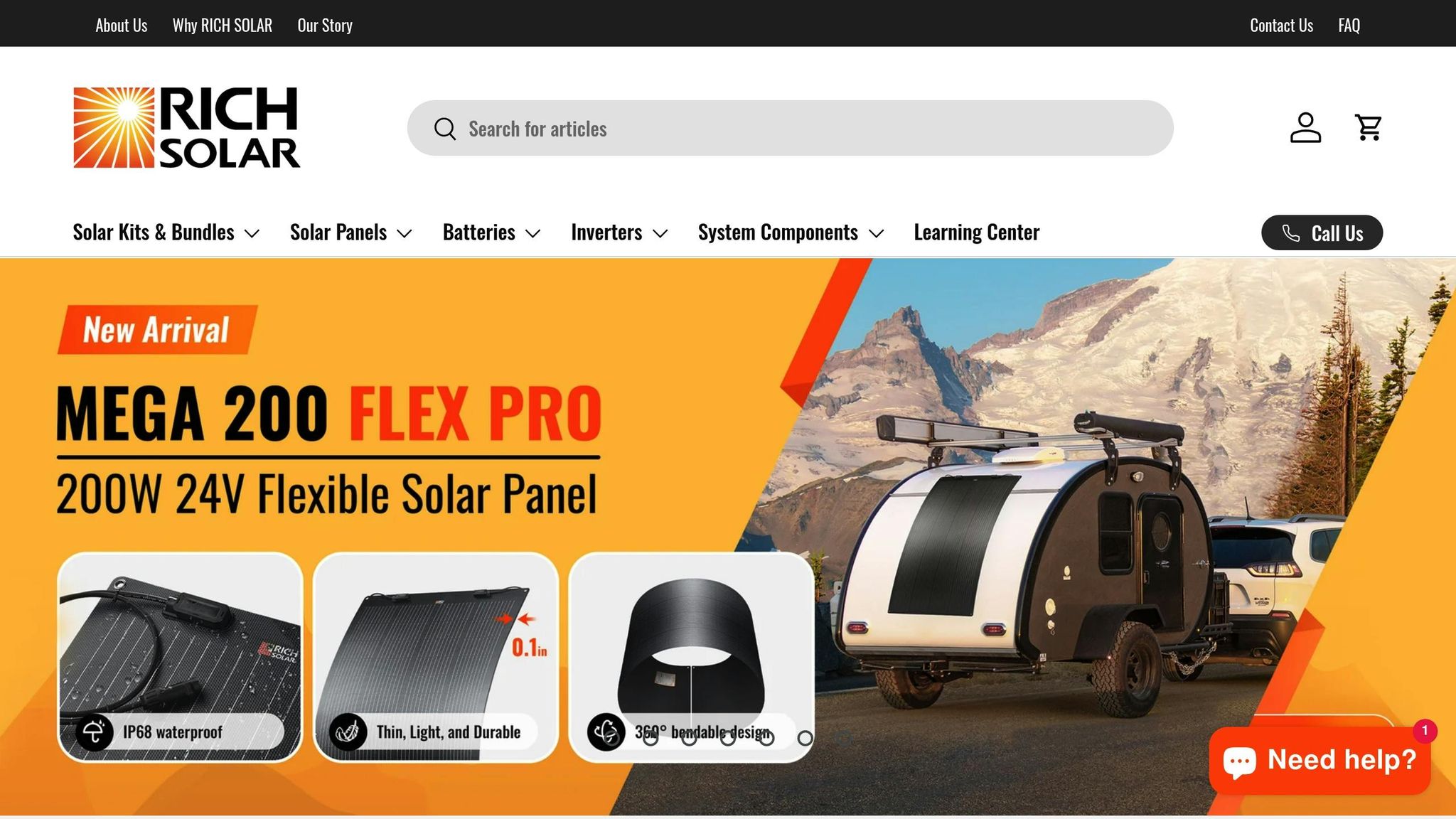
The combination of Battle Born batteries and RICH Solar panels is a top-tier choice for RV enthusiasts seeking scalable power and long-lasting performance. Unlike pre-packaged power stations, this setup allows you to expand your system by adding more batteries or panels as your energy needs grow. Battle Born’s LiFePO4 batteries offer 2–3 times the power and last up to 10 times longer than traditional lead-acid batteries. Meanwhile, RICH Solar panels – available in both rigid and portable 100W designs – are highly regarded for off-grid applications, making them an ideal match for lithium systems. Below, we’ll dive into the key aspects of power output, capacity, portability, and cost that make this system a standout for RVers.
Power Output (W)
RICH Solar panels are available in 100W modules, with additional options like 200W and 250W panels for larger setups. A single 100W panel can generate approximately 500Wh during summer months and around 200Wh in the winter. These panels pair with inverters capable of delivering substantial continuous power, and for appliances with high startup demands, a soft starter can help manage power surges.
Capacity (Wh)
Battle Born’s 100Ah battery provides about 1,280Wh of usable energy, while their larger 270Ah GC3 battery offers roughly 3,456Wh. Unlike lead-acid batteries, which typically allow only 50% depth of discharge, Battle Born batteries utilize 80–100% of their capacity, maximizing energy efficiency. For an RV measuring 21 to 30 feet, a starting setup might include two 100Ah batteries and 200W of solar panels. For more demanding needs, a system with 300–600Ah of battery capacity and 600–1,000W of solar panels can deliver between 3,600Wh and 7,200Wh.
Portability (weight in lbs)
Weighing just 29–31 pounds each, Battle Born batteries are about one-fifth the weight of comparable lead-acid batteries, which can reach up to 150 pounds. These batteries are designed as drop-in replacements, making installation easy without requiring significant modifications to your RV’s battery compartment.
Price Range (USD)
Battle Born 100Ah batteries are priced between $800 and $900 each, while RICH Solar panels range from $119.99 for a 100W panel to $399.99 for a 200W portable briefcase. A fully outfitted system, including 300–600Ah of battery capacity, 600–1,000W of solar panels, a high-quality inverter, charge controller, and monitoring equipment, typically costs between $10,000 and $15,000. While the initial investment is considerable, the long-term benefits are undeniable.
As Matt Knight from Adventurous Way explains:
"If you assume an RV park costs $25 per day, then we’d have spent that amount in just over a year. Living full-time in our RV, our electrical system has already paid for itself."
With a lifespan of 3,000 to 5,000 cycles, Battle Born batteries can last 10–15 years – outperforming three sets of lead-acid batteries during that time. They also charge up to five times faster than lead-acid alternatives. RICH Solar panels come with a 25-year power output warranty and have an impressive average customer rating of 4.8 out of 5, based on over 200 reviews.
System Comparison Table
Choose the system that aligns with your RV lifestyle, budget, and power requirements. The table below highlights key specifications for easy comparison.
| System | Power Output (W) | Capacity (Wh) | Weight (lbs) | Price Range (USD) | Recommended Use Case |
|---|---|---|---|---|---|
| Renogy 400W All-in-One | 2000W | ~2,400Wh (with 200Ah battery) | ~130–150 lbs | $1,500–$2,000 | Full-time van life and DIY permanent setups |
| Jackery Explorer 1000 Plus | 2,000W (3,600W Surge) | 1,264Wh | 22 lbs | $1,000–$1,300 | Weekend camping trips with high portability needs |
| Bluetti AC200Max | 2,200W (4,800W Surge) | 2,048Wh | ~62 lbs | $1,600–$2,300 | Quick solar recharging and powering tools |
| EcoFlow Delta Series | 1,800W–3,600W (7,200W Surge) | 1,024Wh–3,600Wh | 27–99 lbs | $1,000–$3,500 | Fast charging for digital nomads |
| Goal Zero Yeti PRO 4000 | 3,600W (7,200W Surge) | 3,994Wh | ~115 lbs | $2,039.89–$3,399.95 | Off-grid living and backup power |
| ECO-WORTHY 200W Kit | 1,000W (Typical) | ~1,200Wh (with 100Ah battery) | ~60 lbs | $300–$600 | Affordable setups for basic needs |
| Battle Born / RICH Solar | 3,000W (Typical Inverter) | 1,280Wh (per 100Ah battery) | 31 lbs (per battery) | $2,000+ | High-end modular builds with long battery life |
This table provides a quick way to compare systems based on power output, capacity, weight, and price, helping you decide which one suits your off-grid lifestyle. For instance, power output determines how many appliances you can run at once, while capacity tells you how long they’ll last. Weight plays a role in portability – lighter options are ideal for short trips, while heavier systems are better for permanent setups. The price range reflects both upfront costs and long-term value, with premium LiFePO4 batteries lasting 3,000–5,000 cycles.
Use this guide to find the perfect match for your RV’s power needs and travel habits.
Conclusion
As outlined above, the best off-grid power system for your RV depends on your lifestyle and budget. For weekend campers, portable solar generators like the Jackery Explorer or EcoFlow Delta series are a hassle-free choice. These systems are easy to use, require no installation, and can handle basic electronics without altering your RV. On the other hand, full-time RVers may need integrated setups with LiFePO4 batteries, such as Battle Born batteries paired with RICH Solar panels or the Renogy 400W All-in-One Kit. These systems are designed to handle heavier loads like air conditioners and microwaves, last over a decade, and are ideal for extended off-grid living. This comparison highlights options for both casual and full-time RV users.
To choose the right system, start by calculating your daily watt-hour needs. List each appliance’s wattage and runtime, and factor in the number of cloudy days you expect to ensure your system has sufficient reserves. For power-hungry appliances like RV air conditioners, which require about 1,800 watts to start, using a soft start device can reduce the surge, making it possible for smaller systems to manage the load.
"A lead-acid battery might be a better choice if you use your RV only for vacationing, while a lithium battery is better for off-grid living." – GreenCitizen
This guide covers a range of options, from budget-friendly setups like the ECO-WORTHY 200W Kit (around $300–$600) to high-end systems like the Goal Zero Yeti PRO 4000, priced between $2,039 and $3,399. While lithium batteries are more expensive upfront, they offer 3,000 to 5,000 life cycles, making them a cost-effective choice for frequent travelers. Plus, a well-sized solar system can pay for itself in about a year if it helps offset campground fees, which average $25 per day.
For more RV tips, gear reviews, and adventure advice, visit Take More Adventures. Whether you’re upgrading your current system or building one from scratch, the right power setup can make your RV feel like a true home on wheels – ready for wherever your journey takes you.
FAQs
What should I consider when choosing an off-grid power system for my RV?
To pick the best off-grid power system for your RV, start by figuring out your daily energy needs in watt-hours (Wh). Take note of all the appliances you plan to use – like your refrigerator, lights, fans, and other devices – and estimate how much power they consume. This calculation is key to deciding the size of your system, including the number of solar panels and the battery capacity you’ll need.
Next, think about your power generation options. Solar panels are a popular choice – they’re quiet, environmentally friendly, and can be mounted on your RV roof or used as portable setups. However, they work best with plenty of sunlight. If you’re traveling in areas with limited sun or need more power, gas generators are a dependable alternative. While they can handle higher energy demands and cloudy weather, they come with drawbacks like noise and the need for regular refueling. For added flexibility, you could combine both options into a hybrid system, giving you the best of both worlds.
Lastly, pay attention to your battery type and capacity. Lithium batteries, such as lithium-iron-phosphate (LiFePO₄), are a standout choice. They’re lighter, last longer, and charge faster than traditional lead-acid batteries, although they are more expensive upfront. Make sure your battery setup can store enough energy to get you through the night or overcast days. Pair your batteries with a compatible charge controller and inverter for smooth operation. Don’t forget to factor in things like portability, weight, and how the system fits within your RV’s space and budget to create a setup that’s both reliable and efficient for your travels.
How can I calculate the daily power needs for my RV when living off-grid?
To figure out your RV’s daily power needs, start by making a list of all the devices and appliances you plan to use. This includes everything – lights, fans, and kitchen gadgets. For each item, note its power rating (in watts or amps) and estimate how many hours you’ll use it each day. To calculate energy consumption, multiply the power rating by the hours of use. If necessary, adjust for voltage. Add up these values to find your total daily energy requirement, measured in watt-hours (Wh).
Once you’ve determined your daily energy needs, you can size your solar panels and batteries. To find the required solar panel wattage, divide your total watt-hours by the average peak sun hours in your location. Be sure to include an extra 10–20% to account for system inefficiencies. For battery capacity, decide how many days of backup power you’d like. Then, calculate the battery size based on your daily energy use, keeping in mind the type of battery you’re using (like lead-acid or lithium-ion). This method helps ensure your RV setup is ready for a dependable off-grid adventure.
Are lithium batteries a good investment for full-time RV living?
When it comes to full-time RV living, lithium batteries might have a steeper upfront price, but their advantages make them a smart investment in the long run. For starters, they last much longer, so you won’t need to replace them as often. They also offer greater usable capacity, allowing you to power more devices without depleting the battery too quickly. On top of that, they’re lighter and more efficient, which is a big plus when weight and space are at a premium in an RV.
In the long run, these perks can balance out the higher initial cost, making lithium batteries a dependable and budget-friendly option for life on the road.