
Planes vs. Trains: Which Is Greener for Travel?

When deciding between planes and trains, the greener choice is clear: trains. They emit significantly less CO2 per passenger-mile than planes, making them a better option for reducing your carbon footprint.
Key Facts:
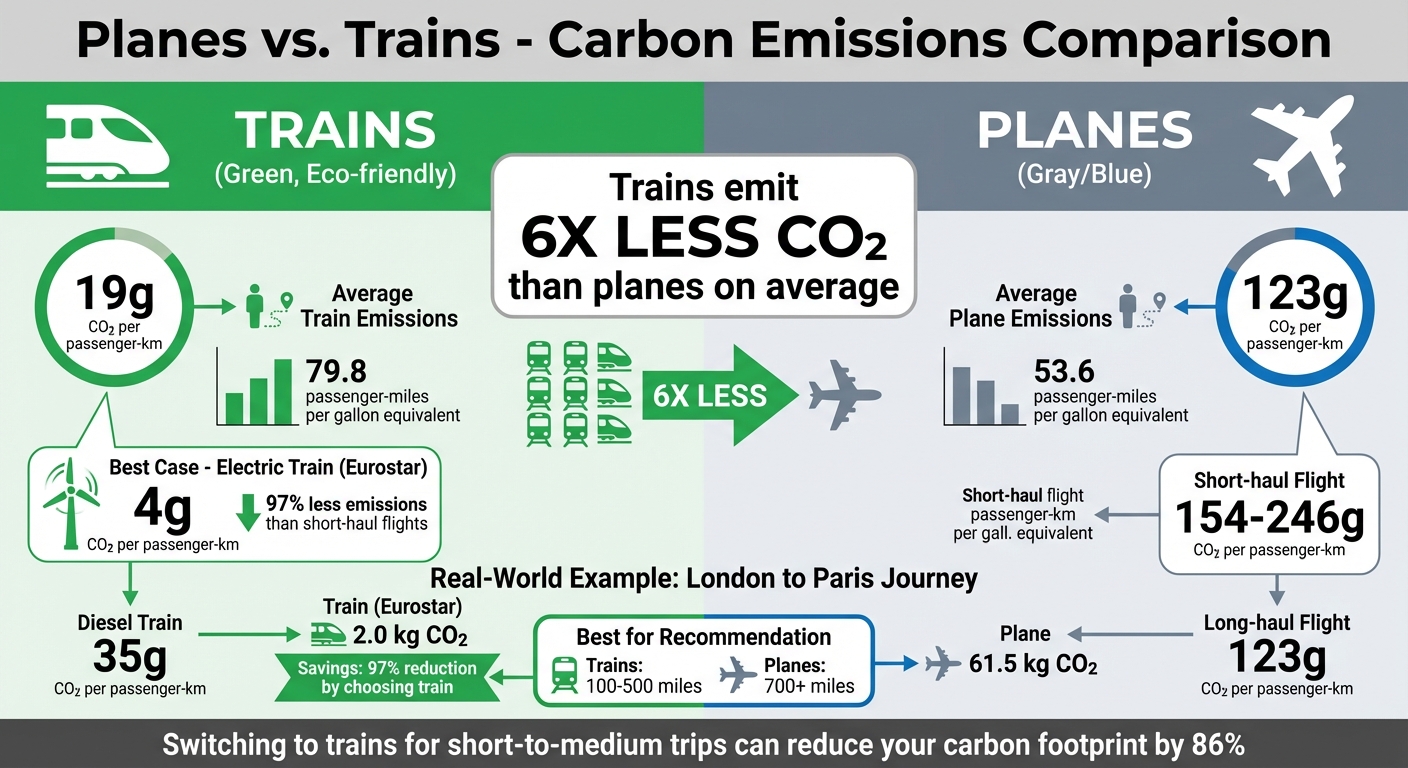
- Planes emit 123g of CO2 per passenger-km, while trains emit just 19g on average.
- High-speed electric trains, like Eurostar, emit as little as 4g of CO2 per passenger-km.
- Short-haul flights are particularly carbon-intensive, with emissions as high as 246g per passenger-km.
- A round-trip flight can generate 227 kg of CO2, compared to just 7.4 kg by train for the same journey.
Why Trains Are Greener:
- Trains are more energy-efficient, achieving 79.8 passenger-miles per gallon equivalent (pmpGGE) compared to 53.6 pmpGGE for planes.
- Electric trains running on renewable energy drastically reduce emissions.
- Rail infrastructure has a higher material recyclability rate compared to airports.
When Planes Make Sense:
For trips over 700 miles, planes may be more efficient than diesel-powered trains. However, choosing economy class and offsetting your carbon footprint can minimize environmental impact.
Quick Comparison:
| Mode | CO2 Emissions (g/passenger-km) | Best Use Case |
|---|---|---|
| Electric Train | 4–19g | Short-to-medium trips (100–500 miles) |
| Diesel Train | 35g | Non-electrified routes |
| Short-haul Flight | 154–246g | Long distances (700+ miles) |
| Long-haul Flight | 123g | Intercontinental travel |
Switching to trains, especially for short-to-medium trips, is a simple way to travel greener. For unavoidable flights, consider carbon offsets and smarter travel choices to reduce your impact.
Planes vs Trains CO2 Emissions Comparison Chart
Carbon Emissions: Planes vs. Trains
Emissions Per Passenger-Mile
When it comes to carbon emissions, trains are far ahead of planes in terms of efficiency per passenger. On average, trains emit just 19g of CO2 per passenger-kilometer (around 0.068 pounds per passenger-mile), whereas planes emit a hefty 123g (about 0.44 pounds per passenger-mile) – over six times more. The difference becomes even more pronounced based on the type of flight or train. For instance, domestic flights can emit as much as 246g per passenger-kilometer, while electric high-speed trains, like Eurostar, emit a mere 4g per passenger-kilometer, cutting emissions by as much as 97% compared to short-haul flights.
| Transportation Mode | Emissions (g CO2 per passenger-km) |
|---|---|
| Eurostar (Electric Train) | 4g |
| Average Train | 19g |
| National Rail (UK) | 35g |
| Short-haul Flight | 154g |
| Domestic Flight | 246g |
In December 2022, Matthew C. Simon from the Volpe National Transportation Systems Center conducted a study for the Federal Railroad Administration, analyzing trips between U.S. cities. His findings confirmed that electric trains consistently had the lowest operational CO2 emissions across all scenarios. These numbers underscore the importance of understanding how energy sources and operational efficiency influence emissions further.
What Affects Emissions
To grasp the emissions disparity between planes and trains, it’s essential to consider factors like flight distance, energy sources, and passenger load. Real-world emissions are shaped by these variables, not just static averages.
For planes, flight distance is a key factor. Takeoff consumes a significant amount of fuel, making shorter flights (typically under 620 miles) the most carbon-intensive on a per-mile basis.
For trains, the energy source is critical. For example, on Amtrak’s Northeast Corridor, electric locomotives emit just 0.134 pounds of CO2 per passenger-mile, while diesel locomotives produce more than double that at 0.280 pounds. The environmental advantage of trains grows when the electricity grid is powered by renewables; electric trains running on clean energy have a much smaller carbon footprint compared to those relying on fossil fuel-heavy grids.
Lastly, passenger load plays a big role in reducing emissions for both modes of travel. Airlines have adopted advanced software to optimize passenger capacity, spreading emissions across more travelers. Similarly, a fully occupied train is far more efficient per passenger than one running half-empty. These factors highlight how operational strategies can impact the overall environmental footprint of each transport option.
Energy Efficiency and Resource Use
Energy Consumption Comparison
Trains manage to achieve approximately 79.8 passenger-miles per gallon equivalent (pmpGGE), while airlines come in at 53.6 pmpGGE. High-occupancy transit rail systems can even reach an impressive 141.4 pmpGGE.
"All forms of rail achieve relatively high values because of high ridership, proportionally low drag, and high electrification rates (electricity is inherently more efficient than combustion-engine propulsion)." – Alternative Fuels Data Center
The efficiency of trains is largely attributed to their design. They face minimal aerodynamic drag on rails and can transport hundreds of passengers at once, spreading energy use across more people. The type of fuel used also plays a critical role in distinguishing the environmental impact of these travel modes.
Fuel Sources and Their Impact
Fuel choice has a big influence on emissions and energy efficiency. Commercial airplanes rely almost entirely on kerosene-based jet fuel, which provides about 135,000 Btu per gallon, while trains typically use diesel (138,700 Btu per gallon) or electricity (3,412 Btu per kilowatt-hour).
Electric trains hold a clear advantage environmentally. Electric motors are much more efficient than combustion engines, and when powered by renewable energy, their carbon emissions drop even further. However, this benefit diminishes in regions where electricity comes from coal-heavy grids – though even then, electric trains often outperform planes.
Aviation is beginning to explore alternatives like Sustainable Aviation Fuel (SAF), which can cut CO₂ emissions by 20–98% compared to traditional jet fuel. In January 2024, LanzaJet Inc. opened a $200 million facility in Georgia to produce 9 million gallons of SAF annually from ethanol. While this marks progress, it’s a small step compared to the 90 billion gallons of jet fuel consumed globally in 2023. For perspective, IAG SA reported that SAF made up just 0.66% of its total fuel usage in 2023, with plans to increase that to 10% by 2030.
What’s the most climate-friendly way to travel 200 miles?
sbb-itb-289f5f2
Comparing Specific Routes
Building on the emissions and efficiency metrics discussed earlier, comparing specific routes highlights how rail travel outperforms air travel in terms of environmental impact.
London to Paris: Eurostar vs. Flights

The London–Paris route is a standout example of rail’s environmental advantage. According to a November 2024 study by EcoRes SCRL, traveling on the Eurostar emits just 2.0 kg of CO2 per passenger, compared to a staggering 61.5 kg for a flight – an impressive 97% reduction in emissions.
What makes the Eurostar so efficient? Two main factors come into play. First, the train operates entirely on electricity, avoiding the fuel-intensive takeoff and climb phases that make air travel so carbon-heavy. Second, France’s electricity grid is around 75% nuclear-powered, which keeps its carbon emissions remarkably low. Plus, the journey itself is quick and convenient: just 2 hours and 16 minutes from London St Pancras International to Paris Gare du Nord.
"The climate effect of non-CO2 emissions from aviation is much greater than the equivalent from other modes of transport, as these non-CO2 greenhouse gases formed at higher altitudes persist for longer than at the surface." – Eloise Marais, Atmospheric Composition Group, University of Leicester
US Routes: Northeast Corridor
Looking at routes in the United States offers additional insight. The Northeast Corridor, connecting cities like Boston and Washington, D.C., demonstrates similar advantages for rail travel. Electrified rail along this corridor produces just 0.134 lb of CO2 per passenger-mile, compared to domestic flights, which average about 0.54 lb per passenger-mile. Annually, this rail line supports 2.31 billion passenger-miles, showcasing its capacity to handle large-scale travel demands.
Rail is particularly competitive for trips between 100 and 500 miles (roughly 160–800 km). When airport wait times and procedures are factored in, door-to-door travel times often match or beat flying, while emissions are typically reduced by 86%.
Other Environmental Impacts
After looking into emissions and energy efficiency, let’s dive into some additional environmental effects.
Noise and Air Pollution
When it comes to noise and air pollution, planes and trains leave different marks. Aircraft release nitrogen oxides (NOx) and water vapor at high altitudes, which can lead to contrails and cloud formation that impact the atmosphere. Meanwhile, air travel’s effects tend to concentrate around airports – think runways, terminals, and surrounding areas.
Trains, on the other hand, distribute their environmental impact more evenly along the length of their tracks. This contrast highlights the localized nature of air travel’s footprint compared to the continuous but less centralized impact of rail systems.
Land Use and Infrastructure
The infrastructure demands for planes and trains are also quite different. Airports need extensive facilities, including runways, terminals, aprons, and air traffic control systems. Rail networks, by contrast, rely on continuous tracks, stations, tunnels, and bridges.
Airports are built to last around 100 years, while rail infrastructure typically has a lifespan of about 35 years. However, airports have a lower material recyclability rate – just 26.3% compared to rail systems, which recycle about 50% of their materials. Rail construction, though, comes with its own challenges, emitting between 58 and 176 tonnes of CO2 equivalent per kilometer annually. These emissions climb even higher in difficult terrains.
"Rail and air travel have significantly different infrastructure requirements that have important implications for environmental impacts over the life cycle of each mode." – C. Andrew Miller, U.S. Environmental Protection Agency
Choosing the Greener Option
Key Takeaways
When it comes to eco-friendly travel, trains generally outshine planes. Trains emit about 31g of CO2e per passenger mile, compared to a hefty 198g for planes – an impressive 86% reduction if you switch from domestic flights to rail. The environmental benefits are even more pronounced on short-haul routes, as highlighted by the earlier Eurostar example.
However, for trips over 700 miles, the equation can change. Diesel trains, due to their indirect routes and fuel type, may end up emitting more CO2 per passenger mile than modern single-aisle jets. Specifically, diesel locomotives emit 0.280 lb of CO2 per passenger mile, compared to just 0.134 lb for electric trains. This makes the power source a critical factor. Electrified routes, like Amtrak’s Northeast Corridor, offer the lowest emissions and the biggest environmental win.
These comparisons are more than just numbers – they can help shape smarter, greener travel decisions. Let’s explore how you can make your trips more eco-friendly.
Tips for Eco-Friendly Travel
- Choose electrified rail for mid-range trips: For journeys between 100 and 500 miles, electrified trains are a great option. They bypass airport hassles and drastically reduce emissions. For instance, Amtrak’s Boston to Washington, D.C. corridor, which runs on electric trains, is a far cleaner choice than driving or flying.
- Know your train’s power source: Before booking, find out if your route uses electric or diesel trains. Electrified lines are significantly better for the environment, so it’s worth checking.
- Use carbon calculators: Tools like the ICAO Carbon Emissions Calculator or Google’s emission estimates can help you compare the environmental impact of different travel options for your specific route.
- Fly smarter when necessary: If flying is unavoidable, opt for economy class to lower your individual footprint. Also, avoid short-haul flights under 300 miles whenever possible – they tend to have a disproportionately high environmental impact.
- Mind the first and last mile: How you get to and from the station or airport matters. Walking, cycling, or using public transit can further cut down your trip’s overall emissions.
- Offset your carbon footprint: For flights or train trips, consider purchasing carbon offsets. For instance, Amtrak offers offsets starting at $5 for 3,000 miles, with options scaling up to $20 for 12,000 miles.
FAQs
Are electric trains better for the environment than diesel trains?
Electric trains stand out as a cleaner and more energy-efficient alternative to diesel trains, primarily because they generate far fewer greenhouse gas emissions. When powered by renewable energy sources, their environmental benefits become even more pronounced, making them a strong choice for reducing carbon footprints.
On the other hand, diesel trains, though not as eco-conscious, still outperform cars and planes in terms of emissions over comparable distances. However, their dependency on fossil fuels places a ceiling on their long-term sustainability. Whenever available, opting for electric trains powered by renewable energy offers the most environmentally responsible way to travel.
How can I minimize my carbon footprint when flying is unavoidable?
If flying is unavoidable, there are steps you can take to lessen its impact on the environment. First, try to book nonstop flights, as takeoffs and landings are responsible for the bulk of a plane’s emissions. Look for airlines that are actively working toward sustainability – these might include those using fuel-efficient planes or investing in renewable energy initiatives. You can also offset your flight’s emissions by purchasing carbon offsets from trustworthy programs. Even small actions, like packing lighter, can contribute by lowering the aircraft’s total weight and fuel consumption.
Why do short flights have a bigger environmental impact than trains?
Air travel leaves a much bigger carbon footprint than train travel, especially on short routes. Planes generate about 123 grams of CO2 per passenger mile, while trains emit only 19 grams. That makes flying roughly six times more polluting than taking the train.
What’s more, the fuel-intensive takeoff and landing stages of a flight significantly boost emissions on shorter trips. Trains, by contrast, are far more energy-efficient over comparable distances, making them a more eco-friendly option for short-haul journeys.