
Is Visiting Animal Sanctuaries Ethical?

Visiting animal sanctuaries can be ethical, but not all sanctuaries prioritize animal welfare. The term "sanctuary" is often misused by facilities that exploit animals for profit. Ethical sanctuaries focus on providing safe, permanent homes for rescued animals without breeding, trading, or allowing direct human interaction. They operate transparently, often as non-profits, and prioritize the animals’ well-being over tourism revenue.
To ensure you’re supporting ethical practices, look for sanctuaries accredited by organizations like the Global Federation of Animal Sanctuaries (GFAS). Avoid places that allow activities like petting, riding, or taking selfies with animals, as these indicate profit-driven motives. Ethical sanctuaries often educate visitors about conservation and provide environments that mimic natural habitats for the animals.
Your visit can either support genuine rescue efforts or fund exploitation. Make informed choices to ensure your travel aligns with animal welfare and conservation goals.
Elephant Sanctuary in Thailand: Watch This BEFORE Booking a Tour!
sbb-itb-289f5f2
What Makes an Animal Sanctuary Ethical?
An ethical animal sanctuary puts the well-being of animals above all else, steering clear of profit-driven motives. These sanctuaries are often non-profit organizations, commonly holding 501(c)(3) status in the U.S., and are dedicated to giving rescued animals a safe and permanent home. Unlike roadside zoos or exploitative attractions that prioritize revenue, true sanctuaries provide animals with a dignified life, free from harm or commercial exploitation.
However, the term "sanctuary" isn’t legally regulated, which means any facility can claim the title. Unfortunately, some facilities misuse this label to attract visitors while engaging in harmful or unethical practices behind closed doors.
Core Principles of Ethical Sanctuaries
True sanctuaries adhere to strict standards: they never breed, trade, or sell animals. Zoologist Dr. Jordan Schaul underscores this point:
"An organization that propagates animals for exhibition isn’t a sanctuary. Placing a monetary value on wildlife perpetuates the commercial trade in wildlife and incentivizes people to breed animals".
Breeding animals in captivity not only strains limited rescue resources but also increases the number of animals living in captivity. Ethical sanctuaries avoid practices like buying, selling, trading, or leasing animals, ensuring that every animal is treated as a living being, not a commodity. These sanctuaries provide lifelong care in enclosures designed to mimic natural habitats, offering ample space and opportunities for social interaction.
Another hallmark of ethical sanctuaries is a strict no-touch policy for wild and exotic animals. Activities like petting, holding, or feeding animals can cause undue stress and shift the focus from their well-being to human entertainment. For instance, Bat World Sanctuary in Texas has taken this principle to heart by eliminating public tours entirely. Instead, visitors can observe the rescued bats on TV screens, ensuring the animals remain undisturbed and stress-free.
These principles form the backbone of what separates ethical sanctuaries from their exploitative counterparts.
Examples of Ethical Practices
Big Cat Rescue in Tampa, Florida is a shining example of ethical sanctuary practices. As of July 2013, this GFAS-accredited facility cares for rescued exotic cats in spacious, naturalistic enclosures, with strict rules prohibiting public contact. To further prioritize animal care, all incoming animals are spayed or neutered immediately, ensuring resources are devoted to their well-being rather than breeding.
Similarly, Lilongwe Wildlife Centre in Malawi focuses on creating species-appropriate environments. Their enclosures cater to the specific needs of each animal: crocodiles have water for bathing, primates can climb trees, and servals can hide in tall grass. When public visits are allowed, they are guided and educational, emphasizing conservation and the unique requirements of rescued animals.
Some sanctuaries go a step further by focusing on rehabilitation. These facilities provide temporary care for injured or orphaned wildlife with the ultimate goal of releasing them back into their natural habitats. Whether offering permanent care or preparing animals for release, ethical sanctuaries maintain complete transparency about their finances, how they acquire animals, and their operational policies. This openness builds trust and ensures their work stays focused on the animals’ best interests.
Red Flags of Unethical Animal Sanctuaries
Common Warning Signs
The term "sanctuary" can be misleading, as it lacks a legal definition. This allows many roadside zoos to misuse the label to attract visitors. A major red flag? Facilities that promote direct interaction with animals.
If a sanctuary lets visitors ride, bathe, hug, pet, or take selfies with wild or exotic animals, it’s a clear indication they prioritize profit over the animals’ well-being. Wendy Higgins, Director of International Media at Humane Society International, puts it plainly:
"A true sanctuary will never encourage or force any animal to interact with people, especially tourists."
Another warning sign is the use of animals in performances. Whether it’s painting, doing tricks, or participating in shows, these activities often involve training methods rooted in fear, using tools like bullhooks, whips, or electric shock devices. The presence of baby animals is also concerning. It often points to speed-breeding operations designed to attract tourists with cute photo opportunities, rather than prioritizing the animals’ needs.
The living conditions of the animals can reveal a lot, too. Look out for cramped or barren enclosures and the isolation of animals that naturally thrive in social groups. Visible injuries, chains, or tethers are clear indicators of poor treatment. Signs of stress, such as pacing or repetitive behaviors, are another red flag. Also, if the facility lacks accreditation from organizations like the Global Federation of Animal Sanctuaries or the American Sanctuary Association, it’s worth questioning their ethics. Legitimate sanctuaries are transparent about their rescue efforts and never treat animals as commodities.
These signs don’t just point to poor conditions – they highlight deeper issues that harm the animals’ overall welfare, as explored below.
How Unethical Practices Harm Animals
The damage caused by unethical practices goes far beyond what’s visible to visitors, leaving lasting scars on the animals’ physical and mental health.
Frequent handling and forced proximity to humans cause immense psychological stress. Animals lose their ability to choose whether or not to interact, a basic freedom they would have in the wild. Training methods often rely on fear and pain, using tools like bullhooks, whips, chains, and electric shocks. This stress, combined with improper diets and constant human interaction, can lead to illness and shortened lifespans. For some species, like sloths, the stress of handling alone can be fatal.
Speed-breeding operations create further harm. These practices sever natural bonds between mothers and offspring and exploit animals for profit. Once these animals are no longer profitable, they are often discarded, sold into the illegal pet trade, or even sent to "canned hunting" operations.
The statistics are sobering. A 2020 report revealed that 63% of captive elephants in Asia live in harsh conditions across 208 locations, with only 7% residing in facilities that meet high welfare standards. In Thailand, the number of captive elephants has risen by 70% over the past decade. Wildlife attractions, which make up 20% to 40% of global tourism, mean millions of travelers unknowingly support these harmful practices.
Wendy Higgins highlights the broader implications:
"Visiting these establishments perpetuates a cycle of animal suffering in which the animals experience boredom, frustration, and even physical pain or fear."
How to Research and Choose an Ethical Sanctuary
Once you’ve learned to spot unethical practices, the next step is figuring out how to identify sanctuaries that genuinely prioritize animal welfare. Here’s how you can do it:
Check for Accreditations
One of the most reliable ways to assess a sanctuary’s commitment to animal welfare is by checking for accreditations. The Global Federation of Animal Sanctuaries (GFAS) is the only internationally recognized organization that certifies sanctuaries. They evaluate facilities based on 26 specific standards, and their accreditation must be renewed every three years. GFAS offers two levels of recognition: Verification and Accreditation. Both require high standards of care, but Accreditation has stricter financial requirements – facilities must maintain reserves for at least three months of operating expenses, compared to one month for Verification.
Other respected accrediting bodies include the American Sanctuary Association (ASA), the Association of Zoos and Aquariums (AZA), and the World Association of Zoos and Aquariums (WAZA). You can search for GFAS-accredited or verified sanctuaries directly on their website.
Keep in mind, accreditation is voluntary, and some ethical sanctuaries may not have it. However, be cautious of sanctuaries relying solely on a USDA exhibitor license – this is not an indicator of ethical practices.
Review Transparency and Policies
Transparency is a hallmark of ethical sanctuaries. Look for organizations registered as 501(c)(3) non-profits, as they typically rely on donations rather than exploiting animals for profit. Before planning a visit, ask the sanctuary key questions like:
- Do you allow breeding?
- Do you sell or trade animals?
- Can I review your recent financial report?
Ethical sanctuaries will answer openly and should have clear policies against breeding, selling, or trading animals. Their mission is to provide lifelong care for rescued animals, not to profit from them. Zoologist Dr. Jordan Schaul emphasizes that facilities breeding animals for exhibition purposes are not true sanctuaries.
Social media can also offer insights. If you notice photos of visitors touching animals, feeding them, or posing for "sloth selfies", that’s a red flag. Accredited sanctuaries, especially those certified by GFAS, strictly prohibit public contact with wild animals, including activities like feeding or bathing them.
Consult Conservation Resources
For further guidance, turn to trusted conservation organizations. Groups like the International Fund for Animal Welfare (IFAW) and PETA provide helpful checklists and resources to evaluate sanctuaries. Travel blogs such as Take More Adventures also offer curated lists of ethical sanctuaries worldwide, making it easier to plan visits that align with conservation values.
Always cross-reference recommendations from these sources with official accreditation databases. Ethical sanctuaries follow strict no-breeding and no-contact policies for wild animals. If a facility allows activities like touching, holding, or taking selfies with exotic animals, it’s prioritizing profit over the animals’ well-being.
Benefits of Supporting Ethical Sanctuaries
Choosing to visit ethical sanctuaries does more than provide a memorable experience – it directly aids in rescuing exploited animals and contributes to conservation efforts. These sanctuaries act as safe spaces for animals saved from the illegal wildlife trade, bushmeat trade, circuses, laboratories, and private ownership. Their focus is on rehabilitation and, whenever possible, reintroducing animals into protected natural habitats. Beyond the animals themselves, these sanctuaries also promote conservation, educate the public, and encourage natural behaviors in their residents.
Conservation and Rescue Efforts
Ethical sanctuaries are instrumental in challenging harmful industries. By refusing to buy, sell, or breed animals, they strip wildlife of monetary value, striking at the heart of industries like the commercial wildlife trade and "canned hunting." For animals that cannot return to the wild, these sanctuaries provide lifelong care in environments tailored to their unique needs. As Fred Tomalin explains:
"Our crocodiles have water to bathe in, our primates have plenty of trees to climb, and our servals have long grass in which to hide."
This commitment ensures that animals can live as close to their natural state as possible, even in captivity.
Educational Opportunities
Ethical sanctuaries also serve as powerful tools for education, raising awareness about conservation and animal welfare. Carson Barylak, Campaigns Manager at the International Fund for Animal Welfare, highlights this aspect:
"Legitimate sanctuaries deliver a strong educational message with each tour, explaining rescued wildlife needs and conservation challenges."
These tours leave a lasting impression. A 2020 Faunalytics study revealed that sanctuary visits can influence attendees to rethink their attitudes, beliefs, and even dietary choices, encouraging more humane and sustainable habits. Visitors learn about pressing issues like biodiversity loss, habitat destruction, and the exotic animal trade, fostering a deeper sense of responsibility toward protecting the natural world.
Promotion of Natural Behaviors
Animal well-being is at the heart of ethical sanctuaries, and they achieve this through enrichment programs designed to promote natural behaviors. These initiatives often use natural materials to keep animals engaged and provide opportunities for self-care, such as access to medicinal plants that animals can choose for themselves. The Captive Animal Enrichment Project emphasizes this goal:
"We create and carry out enrichment programs that improve the lives of animals kept in captivity by supporting their improved mental and physical health. We want more for them than just food and water."
Ethical vs. Unethical Practices: A Comparison
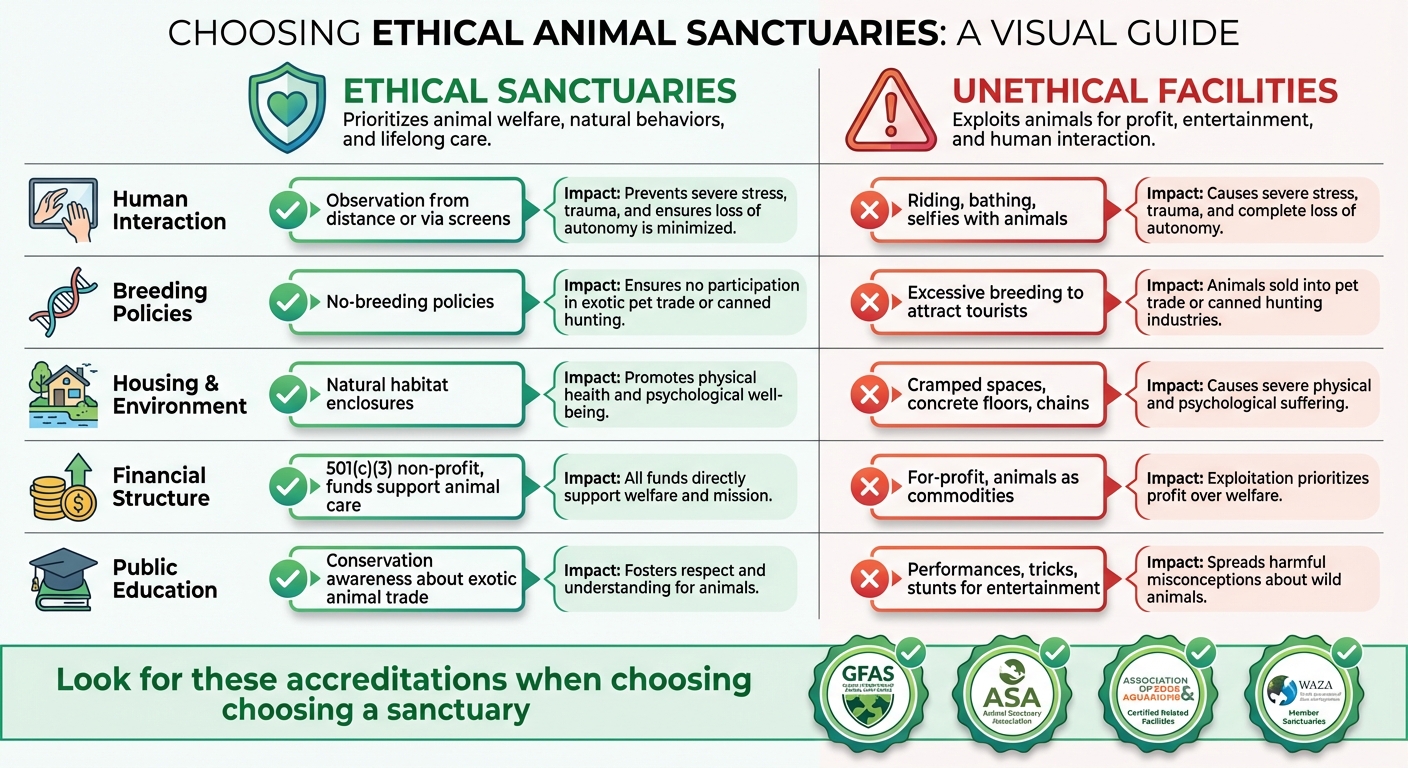
Ethical vs Unethical Animal Sanctuaries: Key Differences
The way sanctuaries treat animals often reveals whether they operate ethically or not. Unfortunately, many facilities use terms like "rescue" or "refuge" to mislead visitors. Understanding the differences in their practices can help you make better choices when planning a visit.
Ethical sanctuaries are typically registered as 501(c)(3) non-profits, dedicated to providing lifetime care for animals without engaging in buying, selling, or trading them. On the other hand, unethical facilities frequently operate as for-profit ventures, exploiting animals through breeding, trading, or using them for entertainment. As Dr. Jordan Schaul points out, any facility that breeds or puts animals on display for profit cannot be considered a true sanctuary.
Here’s a breakdown of the key differences:
Comparison Table
| Practice | Ethical Example | Unethical Example | Impact on Animals |
|---|---|---|---|
| Human Interaction | Observing animals from a distance or via screens | Allowing activities like riding, bathing, or taking selfies with animals | Causes severe stress, trauma, and loss of autonomy for the animals |
| Breeding Policies | No-breeding policies to prevent increasing captive populations | Breeding animals excessively to attract tourists | Often results in animals being sold into the pet trade or "canned hunting" |
| Housing & Environment | Providing enclosures that mimic natural habitats | Keeping animals in cramped spaces, on concrete floors, or in chains | Leads to physical and psychological suffering |
| Financial Structure | Operates as a non-profit, with funds directly supporting animal care | For-profit, using animals as commodities to generate revenue | Encourages exploitation and prioritizes profit over welfare |
| Public Education | Promotes awareness about conservation and the exotic animal trade | Focuses on performances, tricks, or stunts for entertainment | Spreads harmful misconceptions and fosters dependency on humans |
Conclusion
Visiting an ethical animal sanctuary is more than just a travel decision – it’s a way to actively support real animal rescue and conservation efforts. By choosing sanctuaries accredited by organizations like the Global Federation of Animal Sanctuaries (GFAS) or the American Sanctuary Association (ASA), you’re making a powerful statement. Natasha Daly from National Geographic explains it well:
"When travelers decide they want humane treatment of animals, the wildlife tourism market will change for the better."
This choice connects your travel experience directly to meaningful animal welfare initiatives.
Ethical sanctuary visits go beyond sightseeing – they’re a form of advocacy. According to a 2020 Faunalytics study, such visits can influence attitudes, beliefs, and even dietary habits toward more sustainable practices. Supporting legitimate sanctuaries not only helps dismantle the illegal wildlife trade but also ensures rescued animals receive lifelong care.
Every ticket you buy has an impact. It either backs genuine rescue and rehabilitation efforts or supports facilities involved in breeding animals for profit, selling them into the pet trade, or enabling "canned hunting" operations. Make your choice count – support ethical sanctuaries that prioritize animal care and authentic rescue work.
FAQs
How can I tell if an animal sanctuary is ethical?
To figure out if an animal sanctuary operates ethically, pay attention to certain key practices. Ethical sanctuaries are dedicated to rescuing, rehabilitating, and providing lifelong care for animals. They avoid breeding programs or profit-focused activities. Be cautious of places that promote activities like riding, bathing, or direct interaction with animals – these often stress the animals and compromise their well-being.
Trustworthy sanctuaries are frequently accredited by well-known organizations and adhere to strict animal care guidelines. Take the time to research their reputation by reading reviews, asking questions about their operations, and checking if they genuinely prioritize conservation and animal welfare over entertainment. Doing this ensures your support goes to sanctuaries that truly protect and care for animals.
Why is it unethical to interact directly with animals at sanctuaries?
Direct interactions with animals at sanctuaries might seem like a fun and harmless experience, but they often come at a cost to the animals. Activities like riding, bathing, or handling animals can cause stress, disrupt their natural behaviors, and even harm their well-being. Sadly, these practices are often more about generating profit than ensuring the animals’ welfare.
Take animal rides or performances, for example. Behind the scenes, these animals are often subjected to harsh training methods that rely on fear and intimidation. This can lead to lasting physical injuries and psychological trauma. Similarly, activities like holding sloths for photos may seem innocent, but they can cause severe stress, compromise their health, and even shorten their lifespan.
The best sanctuaries focus on creating a safe, natural environment for animals, where they can live without unnecessary human interference. If you’re planning a visit, seek out places that prioritize the animals’ well-being over tourist attractions.
What are the benefits of visiting ethical animal sanctuaries?
Visiting an ethical animal sanctuary can be a deeply rewarding experience, offering benefits not only to the animals but also to those who visit. These sanctuaries are havens for animals rescued from neglect, abuse, or exploitation, providing them with a safe and compassionate environment. Unlike profit-driven facilities, ethical sanctuaries prioritize the animals’ well-being, ensuring their care and dignity come first.
When you visit, you’re not just enjoying a meaningful experience – you’re also playing a part in supporting conservation efforts. Many of these sanctuaries work to educate visitors about critical issues like habitat destruction or the illegal wildlife trade. They inspire more responsible attitudes toward animal welfare and help raise awareness about the challenges animals face. Plus, your visit directly funds the care of these animals and combats harmful practices like roadside zoos or deceptive "sanctuaries." It’s a chance to make a difference while connecting with animals in a way that truly respects their needs.