
How to Vet Travel Companies for Ethical Practices

When choosing a travel company, it’s important to ensure they genuinely prioritize ethical practices. Here’s how you can evaluate their claims:
- Certifications Matter: Look for trusted certifications like B Corp, Green Globe, or those recognized by the Global Sustainable Tourism Council (GSTC). These indicate third-party verification of a company’s ethical and environmental standards.
- Local Ownership and Impact: Check if the company is locally owned and how it reinvests in the community. Locally owned businesses often contribute more directly to local economies.
- Policies on Environment and Human Rights: Review their policies on conservation, waste reduction, and fair labor practices. Look for measurable goals like carbon reduction plans or zero-waste initiatives.
- Transparency: Ethical companies provide annual reports, sustainability disclosures, or impact assessments. Third-party audits validate their claims.
- Animal Welfare and Respect for Local Norms: Ensure they avoid exploitative wildlife practices and work with locals to present authentic experiences without staging or pressuring communities.
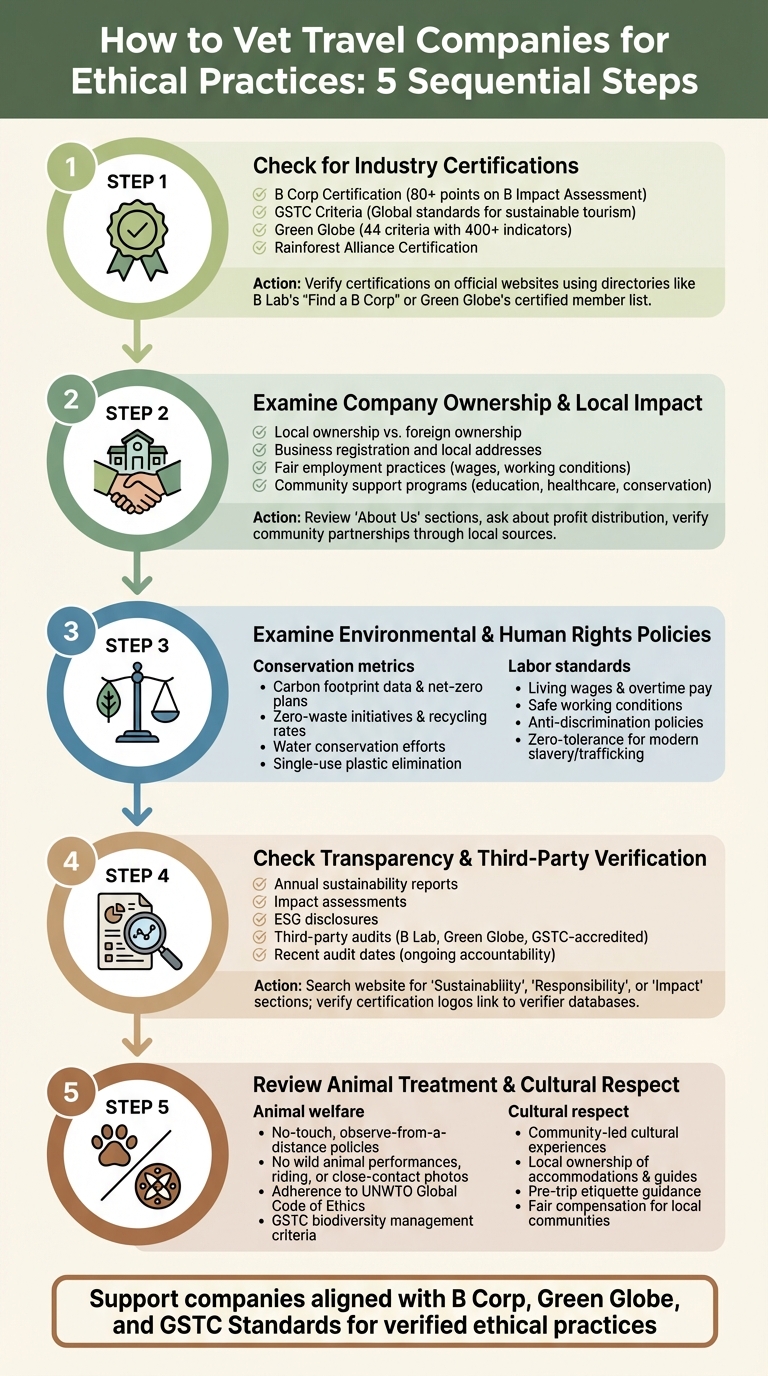
5-Step Process to Vet Travel Companies for Ethical Practices
How to choose a tour operator? TRAVEL TIPS for Mindful Travel 2022 – SUSTAINABLE TRAVEL
Step 1: Check for Industry Certifications
Certifications cut through marketing fluff by relying on third-party evaluations and strict standards. These badges show that an independent organization has assessed a company’s practices against specific benchmarks.
Key Certifications to Look For
Here are some certifications worth paying attention to:
- B Corp Certification: Issued by B Lab, this certification requires businesses to score at least 80 on the B Impact Assessment and legally commit to considering their impact on workers, communities, and the environment – not just shareholders.
- Global Sustainable Tourism Council (GSTC) Criteria: These criteria set global standards for sustainable tourism, covering environmental, social, and economic practices. While GSTC doesn’t directly certify companies, it accredits other certification programs that meet its standards. This makes it a helpful reference for evaluating eco-labels.
- Green Globe: Tailored to tourism businesses, Green Globe certification evaluates companies on 44 criteria, including operations, health and safety, anti-exploitation policies, and environmental management. It requires ongoing audits and aligns with international standards, making it a reliable indicator for hotels, resorts, and tour operators.
- Rainforest Alliance Certification: Commonly seen on eco-lodges and tourism operations in tropical areas like Latin America, this certification ensures environmental protection, fair labor practices, and community benefits. It often aligns with GSTC standards.
How to Confirm Certification Legitimacy
To verify certifications, visit the certifier’s official website or use their directories. For instance, B Lab’s "Find a B Corp" tool and Green Globe’s certified member list can confirm a business’s certification status, location, and name. For GSTC-related certifications, consult the GSTC directory of recognized standards and accredited certification bodies to ensure the eco-label adheres to global best practices.
If you come across an unfamiliar eco-label, ask these questions: Does it outline clear criteria? Are independent audits required? Is it GSTC-recognized or supported by a credible organization? If the answers are unclear, the label might just be a marketing gimmick. When in doubt, contact the certifier directly for clarification.
Step 2: Examine Company Ownership and Local Impact
Looking into a company’s ownership and how it reinvests profits can reveal whether your spending helps local communities. Businesses owned locally tend to keep money circulating within the area – creating jobs and supporting nearby suppliers. On the other hand, companies with foreign ownership may send profits elsewhere, limiting their contribution to the local economy. This step adds an extra layer of understanding beyond certifications, showing the tangible effects a business has on its surroundings.
Choose Locally Owned Companies
Start by checking the "About Us" section on a company’s website. Look for details like business registration, local addresses, and information about the founders. Cross-check these details with local directories or chamber of commerce websites. If in doubt, ask directly: Who owns the company? Where are profits taxed? Is it part of a foreign franchise or parent company?
Also, take a closer look at employment practices. Are there policies ensuring fair pay, safe working conditions, and non-discrimination? Ask guides or staff about their employment status and how long they’ve worked there – this can reveal whether the company values its workers or relies on exploitative practices. Be cautious of businesses offering extremely low prices, as this can sometimes indicate unfair labor practices.
Review Community Support Programs
Genuine community support goes beyond vague promises. Look for specific programs in areas like education, healthcare, conservation, or essential services – such as funding schools, clinics, reforestation projects, or clean water initiatives. Credible companies often share impact reports detailing how profits are being used and naming their NGO or community partners.
The most meaningful efforts are those that involve long-term, community-led partnerships. For example, initiatives that include locals on advisory boards or focus on building local skills show a deeper commitment. To verify these claims, check local news sources or NGO reports. If a company doesn’t provide recent updates or measurable results, their support may not be as genuine as it seems.
Step 3: Examine Policies on the Environment and Human Rights
After exploring certifications and community practices, it’s time to dig into a company’s internal policies. These documents are a window into how seriously a business takes its responsibility to protect the environment and uphold fair treatment of workers. Check out the "Sustainability" or "Policies" section on their website, where you can often find downloadable materials. If you notice vague or missing commitments, it’s a warning sign that the company’s ethical priorities might not be genuine. Reviewing these policies adds another layer to your understanding of their certifications and community impact.
Check Their Approach to Conservation
Strong conservation policies should include measurable goals. Look for details like carbon footprint data, plans for achieving net-zero emissions, or participation in carbon offset programs. Companies following GSTC Standards often highlight specific sustainability metrics, such as annual reductions in emissions. For waste management, see if they mention zero-waste initiatives, recycling rates, water conservation efforts, or strategies to eliminate single-use plastics. Standards like Green Globe require responsible sourcing and waste reduction practices, with clear results like cutting down landfill waste.
Also, pay attention to whether the company prioritizes local suppliers and avoids harmful products. These choices can minimize transportation emissions and reduce environmental damage. B Corp-certified companies, for instance, are held to rigorous environmental standards and must publicly report their performance on B Lab’s website. If a company can’t provide concrete numbers or timelines for its conservation plans, it’s likely their commitment doesn’t go beyond surface-level promises.
Review Labor and Human Rights Standards
Ethical responsibility doesn’t stop at environmental goals – it extends to how companies treat their workers. Fair labor practices ensure that your money supports businesses that value their employees. Look for policies that address living wages, overtime pay, and safe working conditions, going beyond the bare legal minimum. Green Globe’s criteria, for example, include specific measures to prevent exploitation and guarantee health and safety, with clauses against child labor and forced labor.
Check for anti-discrimination policies that protect against bias based on age, gender, race, and other factors. Ethical companies also commit to diversity and have zero-tolerance policies for modern slavery, human trafficking, or bribery. If these protections are unclear or missing, don’t hesitate to reach out to the company directly with questions about worker treatment and supply chain practices. Transparent businesses will openly share their standards and provide clear channels for reporting violations.
sbb-itb-289f5f2
Step 4: Check for Transparency and Third-Party Verification
Once you’ve reviewed a company’s internal policies, the next step is ensuring they back up their promises with clear data and independent oversight. Companies committed to ethical practices don’t just make claims – they provide evidence. This transparency helps you distinguish between businesses that genuinely uphold their values and those that rely on empty words. Independent verification serves as a bridge between stated policies and actual practices, giving you confidence in your choices.
Find Public Reports and Disclosures
Start by exploring the company’s website for sections labeled "Sustainability", "Responsibility", "Impact", or "Reports." These are often located in the footer or main menu. Many ethical travel companies publish annual sustainability reports, impact assessments, or ESG (environmental, social, and governance) disclosures, which provide measurable data about their performance. For example, B Corp–certified companies share their B Impact Assessment scores on B Lab’s website. Achieving certification requires a score of at least 80 points and passing a risk review.
Similarly, Green Globe–certified businesses adhere to 44 criteria supported by over 400 indicators, often detailed in annual reports that align with ISO 21401 standards for measurable sustainability outcomes. If you can’t find these documents on the company’s site, use the search bar or contact them directly to request access. A lack of transparency here might indicate the company isn’t as committed as it claims to be.
Look for Outside Audits
Third-party audits are a key step in verifying a company’s ethical claims. Trusted audits are conducted by internationally recognized organizations such as B Lab, Green Globe, or GSTC-accredited programs. These entities evaluate performance based on standardized criteria, using methods like on-site inspections and ongoing monitoring. Look for certification logos on the company’s website, which should link to the verifier’s database. This allows you to confirm the validity of their certification and review audit summaries. For example, Green Globe certifications align with ISO 21401 standards, ensuring compliance with global best practices.
Make sure the audits are recent, as this demonstrates ongoing accountability rather than a one-time effort. The Global Sustainable Tourism Council (GSTC) provides baseline criteria online, making it easier to check whether a company meets global standards. Without independent audits, a company’s claims could be unverified, leaving room for greenwashing. If a business makes bold "eco" or "responsible" claims but lacks reports or third-party verification, consider it a warning sign and look for alternatives that prioritize transparency. Keep evaluating their ethical practices as you move forward.
Step 5: Review Animal Treatment and Respect for Local Cultures
After examining certifications, community impact, and policy transparency, the next step focuses on how businesses handle animal welfare and honor local traditions. These aspects go a long way in revealing whether a company is genuinely committed to ethical practices or merely using them as a marketing ploy. Evaluating these areas provides a clearer picture of the company’s integrity.
Check Animal Treatment Standards
Start by reviewing the company’s animal welfare policies. Look for clear statements against activities like wild animal performances, riding, baiting, or close-contact photo opportunities. Ethical operators stick to no-touch, observe-from-a-distance policies and partner with reputable sanctuaries that avoid breeding animals for entertainment purposes. Be cautious of businesses promoting activities like elephant rides or big cat petting, as these often involve cruelty despite being marketed as "animal friendly."
Also, check if the company adheres to recognized frameworks like the UNWTO Global Code of Ethics for Tourism, which emphasizes wildlife respect and avoiding exploitation. Companies aligned with Global Sustainable Tourism Council (GSTC) criteria are required to manage their biodiversity and animal welfare impacts as part of their broader sustainability efforts. Asking specific questions, such as "Are your elephants ridden or chained?" or "How long do working animals like horses or camels labor each day?" can help gauge their commitment to animal welfare. Transparent, detailed answers are a good sign.
Don’t forget to read recent reviews for any signs of animal mistreatment. Additionally, verify any conservation partnerships through reliable sources. Ethical wildlife experiences focus on observation in natural or semi-natural settings, enforce limits on group sizes and visit durations, and strictly prohibit feeding or touching animals.
Assess Respect for Local Traditions
Ethical companies actively engage with local communities to ensure their culture is represented authentically. They work with community members who lead or host cultural experiences instead of relying on outsiders to stage them. Look for businesses that provide pre-trip guidance on local etiquette, such as dress codes, photography rules, and religious practices, and that encourage visitors to respect these norms rather than creating artificial performances for tourists. Investigate ownership and revenue distribution to confirm that local communities are fairly involved and compensated.
Companies that prioritize local involvement often use locally owned accommodations, restaurants, and guides, and source goods and services from local suppliers. Ethical operators also provide on-site briefings to educate visitors on topics like when it’s appropriate to take photos of people, ceremonies, or sacred objects. They train their guides to step in if guests act disrespectfully. Authentic cultural experiences are led by community members who choose what to share, are compensated fairly, and maintain control over how often these activities occur. Avoid tours that pressure locals – especially children – into performing or posing for photos, or that stage rituals outside their usual context just to entertain tourists.
Conclusion
Every ethical decision you make can turn travel into a meaningful force for positive change. Taking the time to evaluate travel companies for their ethical practices ensures your choices contribute to lasting improvements. By following these five steps – checking certifications, examining local ownership and impact, reviewing environmental and human rights policies, verifying transparency, and assessing animal welfare and cultural respect – you can confidently support businesses that prioritize responsibility over mere profit.
Certifications from organizations like B Corp and Green Globe are more than just labels; they represent a genuine commitment to high ethical standards, backed by measurable benchmarks and ongoing evaluations. These certifications demonstrate that a company is serious about its impact, not just its image.
Opting for companies that champion local conservation, employ community-based guides, and respect both animal welfare and cultural heritage creates sustainable supply chains that benefit entire regions. This approach aligns with global frameworks such as the Global Sustainable Tourism Council (GSTC) Standards and the Global Code of Ethics for Tourism, fostering a culture of transparency and accountability.
FAQs
How can I confirm a travel company’s certifications are legitimate?
To verify a travel company’s certifications, begin by checking the official website of the organization that issued the certification. Many of these organizations provide a verification tool or have a support team you can contact to confirm the credential’s authenticity. Make sure the certification aligns with respected standards, such as those established by the Global Sustainable Tourism Council (GSTC) or other well-regarded entities. Taking this step can help ensure the company adheres to ethical and sustainable practices.
What questions should I ask to evaluate a travel company’s impact on local communities?
To understand how a travel company impacts the local area, consider these key points:
- Economic support for the community: Does the company hire local employees or purchase goods and services from nearby businesses? This can be a strong sign of their commitment to the local economy.
- Involvement of local communities: Are locals included in the decision-making process? This ensures their perspectives are valued and respected.
- Efforts to protect local heritage and the environment: Check if they run programs to preserve traditions or adopt eco-conscious practices.
- Fair treatment of local workers: Do they provide fair wages and safe working conditions? Ethical labor practices speak volumes about a company’s values.
- Partnerships with local artisans and businesses: Collaborating with small, local enterprises helps sustain the community’s economy and cultural traditions.
By considering these factors, you can choose a travel company that prioritizes ethical and responsible practices, ensuring your visit leaves a positive mark on the destination.
How can I tell if a travel company values animal welfare and local cultures?
When evaluating a travel company, start by examining their stance on animal welfare and respect for local traditions. Look for explicit commitments to ethical practices, like avoiding harmful animal interactions and honoring the customs of the communities they operate in. Certifications from respected ethical travel organizations can also signal that the company upholds high standards.
It’s also worth diving into traveler reviews to see if real experiences match the company’s promises. Companies that truly care about supporting local communities often work with local organizations or hire local guides – details like these can reveal a lot. Pay attention to their level of transparency too. If a company is open about their sustainable and ethical practices, it’s usually a strong indicator that they genuinely value these principles.