How Tiny Cabins Reduce Travel Impact

Tiny cabins are reshaping how we travel by offering eco-friendly stays that minimize impact. These small spaces (under 400 sq. ft.) use fewer resources and encourage simpler lifestyles, making them a smart alternative to hotels. Here’s why they matter:
- Energy Savings: Tiny cabins consume less energy for heating, cooling, and lighting. Many use solar panels and high-efficiency materials, cutting carbon emissions by up to 96%.
- Lower Construction Impact: Building these cabins requires fewer materials and causes less land disruption compared to large hotels.
- Minimal Waste: Features like composting toilets, rainwater systems, and shared resources reduce waste and water use.
- Smaller Footprints: Residents or guests of tiny homes use an average of 3.87 global hectares, compared to 8.4 for most Americans.
100% OFF-GRID AND A ROOF TOP DECK? ONE OF OUR MOST UNIQUE TINY HOMES TO DATE!
sbb-itb-289f5f2
The Problem: How Conventional Travel Accommodations Harm the Environment
Traditional hotels and resorts come with a hefty environmental cost. The tourism industry is responsible for about 8% of global carbon emissions, and hotels alone contribute roughly 1% of that total. This impact starts well before guests arrive and continues throughout their stay, with inefficiencies in energy use, construction practices, and waste management paving the way for more sustainable lodging options.
High Energy Consumption in Traditional Accommodations
Hotels operate around the clock, powering everything from guest rooms to lobbies, banquet halls, laundries, and kitchens. A significant portion of this energy is wasted. For instance, heating and cooling unoccupied spaces – guest rooms are empty on average 12 hours a day – accounts for nearly 65% of a hotel’s energy use, with lighting adding another 25%. On top of that, energy expenses typically make up about 6% of a hotel’s annual operating costs.
Resource-Intensive Construction Practices
Building large hotels demands enormous amounts of materials like concrete, steel, and furniture, contributing to 39% of global construction-related emissions. This process often involves clearing large tracts of land, which disrupts local ecosystems. A study from UC Berkeley’s Renewable & Appropriate Energy Laboratory in January 2022 highlighted the stark contrast between conventional and smaller-scale structures. The research, centered on the Tiny House in My Backyard (THIMBY) project, revealed that an 18.5 m² (approximately 200-square-foot) living space produced 96% fewer carbon emissions than a typical 2,100-square-foot California home. As Louise Southerden, a contributor to World Nomads, explains:
"Small rooms and structures also require less embodied energy and fewer materials to build, less damage to trees and the land they inhabit… all of which adds up to less impact on the planet".
But the environmental toll doesn’t stop at energy and construction; waste is another major issue.
Excessive Waste from Overconsumption
Conventional hotels generate an alarming amount of waste. Disposable toiletries, single-use plastics, and leftover food from buffets all add to the carbon footprint of a stay. Water usage is another area of concern. Maintaining sprawling lawns, frequently laundering linens, heating pools, and irrigating landscapes consume vast amounts of water, often straining local resources. These challenges underscore the pressing need for sustainable alternatives, such as tiny cabins, that minimize environmental harm.
How Tiny Cabins Reduce Travel Impact
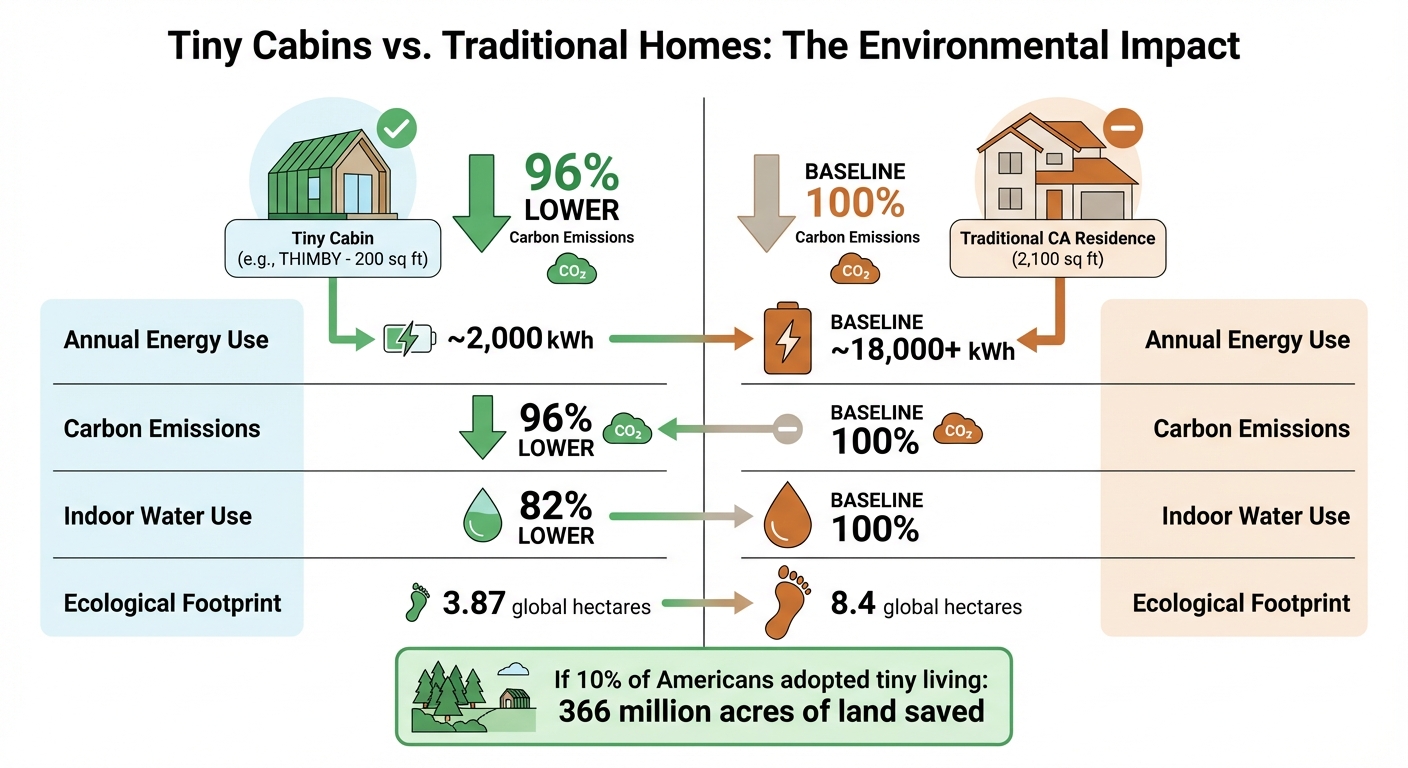
Tiny Cabins vs Traditional Homes: Environmental Impact Comparison
Tiny cabins are designed to use less energy, fewer materials, and leave a smaller footprint compared to traditional accommodations. Their compact size offers benefits right from construction through daily use. Let’s dive into how energy efficiency, reduced material needs, and a minimalist lifestyle make tiny cabins a smart choice for eco-conscious travelers.
Energy Efficiency of Tiny Cabins
Smaller spaces naturally require less energy to heat and cool, making tiny cabins inherently more efficient. High-performance insulation – crafted from materials like recycled denim, sheep’s wool, or carbon-negative cork – helps maintain stable indoor temperatures by reducing heat transfer. Many cabins also employ passive design strategies, such as cedar slats or adjustable awnings for shading, and reflective "cool roofs" to minimize heat absorption. Some even incorporate advanced materials like phase-change substances in ceilings, which absorb heat during the day and release it at night.
Renewable energy systems are another key feature. Tiny cabins can often run entirely on compact solar arrays paired with battery storage. A standout example is UC Berkeley’s "Tiny House in My Backyard" (THIMBY), a 200-square-foot off-grid cabin powered by a 2.3-kilowatt solar array and Tesla Powerwall. THIMBY consumed just 2,000 kWh annually – an 89% reduction in energy use compared to the average California home – and cut carbon emissions by 96%.
Energy savings are further amplified by efficient appliances. Tiny cabins often feature CO₂ heat pump water heaters, energy recovery ventilators, and ultra-low-wattage ceiling fans (using as little as 4–18 watts). These systems provide comfort without the high energy demands of traditional air conditioning. Brett Webster, Manager of RMI‘s Carbon-Free Buildings Program, highlights the effectiveness of airflow:
"Airflow creates a cooling sensation that’s extremely effective".
| Metric | Tiny Cabin (e.g., THIMBY) | Traditional CA Residence |
|---|---|---|
| Annual Energy Use | ~2,000 kWh | ~18,000+ kWh |
| Carbon Emissions | 96% Lower | Baseline (100%) |
| Indoor Water Use | 82% Lower | Baseline (100%) |
| Ecological Footprint | 3.87 global hectares | 8.4 global hectares |
With efficient insulation, LED lighting, and low-flow fixtures, tiny cabins significantly cut both energy and water consumption.
Minimal Construction and Material Requirements
Tiny cabins require far fewer materials than standard buildings, which directly reduces the embodied energy – energy used in material extraction, manufacturing, and transportation. These small-scale builds inherently demand less energy-intensive processes.
Many builders prioritize sustainable and reclaimed materials. FSC-certified timber supports forest conservation, while fast-growing bamboo (which can grow nearly 3 feet per day) offers a renewable alternative. Reclaimed wood, recycled metal, and repurposed shipping containers reduce landfill waste and limit the need for new raw materials.
The construction process itself is also gentler on the land. Foundations like ground screws or concrete piers cause minimal soil disturbance compared to large-scale excavations. Prefabricated kits further reduce environmental impact by streamlining factory production, which cuts construction time and site disruption – often at a 10% to 20% lower cost than traditional methods.
Encouraging Minimalism and Resource Sharing
Tiny cabins do more than save energy and materials – they inspire a simpler, more intentional way of living. With limited space, guests are encouraged to pack light, focusing on versatile essentials. Compact kitchens and minimal storage naturally lead to purchasing fewer items, generating less waste, and making choices like sourcing local produce.
A 2019 doctoral study at Virginia Tech found that tiny home residents reduced their ecological footprints by 45% on average – from 7.01 to 3.87 global hectares – while adopting more sustainable habits. Researcher Maria Saxton noted:
"Downsizing was an important step toward reducing ecological footprints and encouraging pro-environmental behaviors".
Tiny cabin communities often take sustainability a step further by sharing resources. Tool libraries, communal gardens, and food co-ops reduce individual consumption while fostering connections within local economies. Technologies like composting toilets and greywater systems also play a role, eliminating water waste and reusing sink and shower water for irrigation. If just 10% of Americans embraced tiny living, it could save around 366 million acres of biologically productive land.
Through thoughtful design and community-driven practices, tiny cabins offer a meaningful way to travel while minimizing impact.
Tips for Low-Impact Tiny Cabin Stays
Making eco-conscious choices when staying in tiny cabins can help reduce your environmental footprint. Start by choosing accommodations with proven sustainable features. Look for cabins equipped with solar panels, composting toilets, and materials that are either FSC-certified or reclaimed. Additional features like rainwater harvesting systems and greywater recycling signal a strong commitment to sustainability. For instance, properties such as the Portland Tiny House Hotel in Oregon offer easy access to local food sources like farmers’ markets and food co-ops, which can help cut down on transportation emissions. Once you’ve chosen your stay, you can take further steps to minimize your impact.
Travel light to reduce emissions. Packing lighter – around 15 pounds less – can lower travel-related emissions by nearly 80 pounds on a ten-hour flight. Stick to essentials, and replace single-use items with reusable alternatives like water bottles, tote bags, and refillable toiletry containers. When you arrive, continue conserving resources by taking shorter showers, reusing towels, and turning off heating or cooling systems when you’re not in the cabin. These small actions can add up to a meaningful difference.
Get involved with local eco-communities. Participating in sustainable practices during your stay can amplify your positive impact. In the U.S., some eco-lodges encourage guest involvement, similar to international examples like Kolarbyn Eco-Lodge in Sweden, where guests chop wood and collect water, or Ecolodge La Estancia in Bolivia, which invites guests to assist with farm work. You can also shop at nearby co-ops or volunteer for local environmental projects. As Louise Southerden, a contributor to World Nomads, explains:
"Small accommodation options can help us tread more lightly on the places and communities we visit and not just because they’re often locally owned, ensuring that what you pay stays local".
In a tiny cabin, every decision counts – including your food choices. Opting for locally sourced meals supports regional farmers and reduces "food miles." Sharing dishes or ordering smaller portions can also help cut down on food waste, which often ends up in landfills and produces methane. Since food production accounts for roughly 25% of global emissions, even small adjustments in your dining habits can make a notable difference.
Conclusion
Tiny cabins allow you to explore responsibly, blending comfort with a smaller environmental impact. These compact getaways consume much less energy for heating and cooling, use fewer construction materials, and often incorporate eco-friendly systems like off-grid solar panels and rainwater collection. Research has shown that downsizing to tiny homes can dramatically shrink ecological footprints, proving that smaller accommodations can make a big difference.
"When it comes to where you stay, small is beautiful – and eco-friendly".
This efficiency doesn’t just benefit the environment – it enriches your travel experience by aligning adventure with sustainability.
The ripple effect of such choices is profound. For instance, if just 10% of Americans transitioned to tiny homes, it could preserve around 366 million acres of biologically productive land. Every tiny cabin stay contributes to a more sustainable future for travel.
FAQs
Why are tiny cabins so energy-efficient?
Tiny cabins are impressively energy-efficient, thanks to their compact size – usually ranging from 100 to 400 square feet. With significantly less space to heat, cool, and light compared to the average 2,600-square-foot American home, energy demand drops by more than 50%. On top of that, designers incorporate features like high-performance insulation made from recycled materials, airtight construction, and clever shading techniques to further cut down on heating and cooling needs.
Many of these tiny dwellings also embrace off-grid living. Solar panels, energy-efficient appliances, LED lighting, and low-flow water fixtures are often standard. Paired with smart energy management systems, these features keep energy use low while still offering a cozy and functional space. The combination of a smaller footprint, intentional design, and sustainable technology makes tiny cabins an excellent option for those looking to reduce their environmental impact.
How do reclaimed materials in tiny cabins benefit the environment?
Building tiny cabins with reclaimed materials is a smart way to cut down on their impact on the planet. By using salvaged wood, doors, windows, and other components, you avoid the energy-heavy process of creating new materials. Plus, it keeps waste out of landfills, reduces leftover construction debris, and limits the demand for raw resources like timber and steel, which helps preserve ecosystems and natural habitats.
Smaller cabins crafted from repurposed materials don’t just use fewer resources during construction – they’re also easier to maintain. For travelers, choosing to stay in these eco-conscious cabins supports a more sustainable way of living while offering a cozy and one-of-a-kind escape that fits perfectly with efforts to travel more responsibly.
How does staying in a tiny cabin promote eco-friendly travel?
Staying in a tiny cabin is a great way to minimize your impact on the planet. These snug retreats use fewer resources and consume less energy than traditional accommodations. Since they’re smaller, they require less material to build and often come equipped with energy-saving features like solar panels or propane heaters. Plus, their compact size means you’ll need less energy to keep the space warm in the winter or cool in the summer, making them a more eco-friendly option for travelers.
Tiny cabins also nudge you toward greener habits. With limited storage space, you’re more likely to pack light, bring reusable essentials, and produce less waste. Many of these cabins even include composting options or recycling bins to help reduce trash. Beyond that, the simplicity of tiny cabin living can inspire a shift toward a more sustainable lifestyle. Opting for a tiny cabin not only ensures a low-impact getaway but also offers a cozy, nature-centered escape that reflects the values of sustainable travel.