Regenerative Tourism: Helping Remove Invasive Plants

Conventional tourism often harms local ecosystems, but regenerative tourism flips the script by actively restoring them. Instead of just sightseeing, travelers participate in hands-on conservation efforts like removing harmful plants and planting native species. This approach not only improves biodiversity but also strengthens local economies by reinvesting tourism income into restoration projects.
Key differences between regenerative and conventional tourism:
- Regenerative tourism: Travelers actively contribute to restoration efforts, such as removing harmful plants. It promotes biodiversity and supports local communities.
- Conventional tourism: Focuses on sightseeing, often leading to ecosystem damage, habitat loss, and the spread of harmful species.
Programs like Global Family Travels and Hands Up Holidays make it easy to plan trips that combine learning and conservation. If you want your travels to leave a positive impact, consider joining these efforts to protect and restore natural habitats.
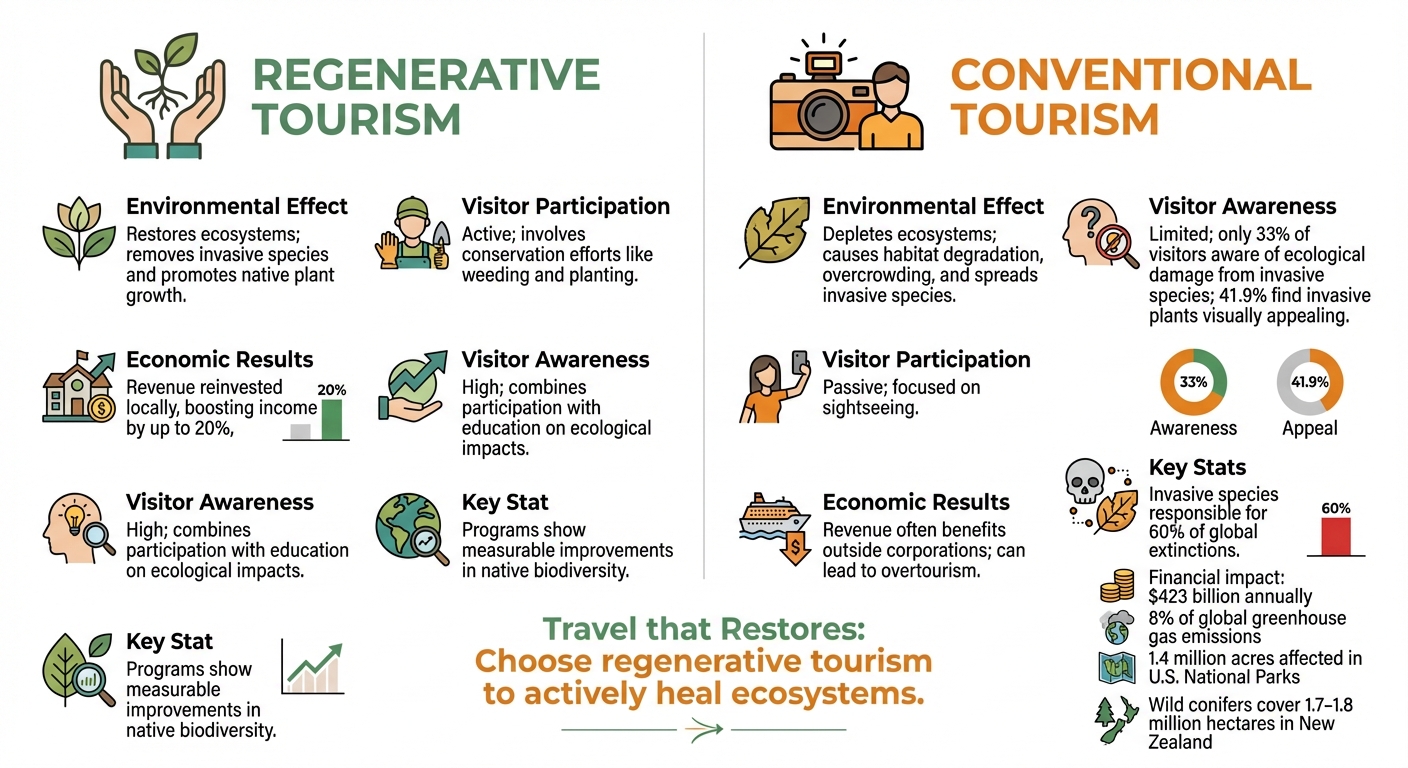
Regenerative vs Conventional Tourism: Environmental and Economic Impact Comparison
1. Regenerative Tourism
Environmental Impact
Regenerative tourism takes a hands-on approach to ecosystem restoration. Instead of just enjoying scenic views, travelers actively participate in efforts like removing invasive plants from riverbanks, clearing non-native species from coastal prairies, and repairing hiking trails. These volunteer-led activities have shown real success in boosting native biodiversity. From coastal habitats that support endangered species to river systems vital for salmon, this approach creates measurable, lasting improvements. It’s a step beyond the usual "leave no trace" philosophy – this is about actively improving the environment.
Visitor Involvement
In this model of tourism, visitors transform into active participants, not just spectators. Many programs adopt a "Learn, Serve, Immerse" approach. Travelers receive hands-on guidance from local conservation groups and community members, learning about the threats invasive species pose to ecosystems. Then, they roll up their sleeves to weed, plant, and clear trails alongside experienced locals. Volunteer Jean Carideo summed it up perfectly:
"It’s one thing to read, see, or hear about an ecological danger, but it’s another to physically do something about it, alongside others who want to do something, too".
This kind of involvement deepens the connection between visitors and the environment they’re helping to protect.
Long-Term Outcomes
The impact of regenerative tourism doesn’t end when the trip is over. As Kieron Wilde, founder of First Nature Tours, puts it:
"You get that long-term connection when you have a tree that might be there for a good 50 years plus – a tree you can come back and see".
Many participants take the lessons they’ve learned back home, adopting conservation practices in their daily lives. Beyond environmental benefits, local communities also gain economically. For example, after the 2020 Holiday Farm Fire in Oregon, which burned 173,000 acres, regenerative tourism efforts focused on reforestation and trail restoration provided much-needed support to small businesses in the area. This approach not only helps rebuild ecosystems but also strengthens local economies. It’s a model that highlights the value of active participation, offering a sharp contrast to more traditional forms of tourism.
2. Conventional Tourism
Environmental Impact
Conventional tourism, often referred to as extractive tourism, focuses on short-term enjoyment but leaves little room for ecological responsibility. One of its unintended consequences is the spread of invasive species. Tourists, through their equipment and footwear, can unknowingly transport these species, which are responsible for 60% of global plant and animal extinctions. The financial toll is staggering, exceeding $423 billion annually.
Tourism marketing often exacerbates the problem by emphasizing visuals over ecological health. In New Zealand, for instance, invasive species like Russell lupins and wild conifers are frequently featured in promotional materials due to their aesthetic appeal. However, these plants pose a serious threat to native ecosystems. Wild conifers alone cover 1.7–1.8 million hectares in New Zealand, spreading at a rate of about 5% annually. Similarly, in U.S. National Parks, invasive species have taken over approximately 1.4 million acres. This focus on beauty rather than ecology highlights a passive approach to tourism that neglects environmental stewardship.
Visitor Involvement
Tourists often take on the role of passive spectators rather than active participants in conservation. A 2022 study in New Zealand’s Mackenzie Basin revealed that only 33% of visitors were aware of the ecological damage caused by invasive wild conifers. Among international tourists, awareness was even lower, at just 25%, compared to 55.4% among domestic visitors. Surprisingly, 41.9% of those surveyed found the invasive conifers visually appealing, perceiving them as an enhancement to the landscape.
This lack of awareness undermines conservation efforts. As Brent Lovelock and his colleagues at the University of Otago observed:
"The public’s awareness of IAS [Invasive Alien Species] is low… IAS are not a concern to the public unless they pose a threat to nature, the economy of an area, or human health".
When invasive plants are seen as attractive additions to the scenery, tourists may resist removal efforts, even when these species threaten local biodiversity. This hands-off attitude contrasts sharply with the more engaged approach seen in regenerative tourism.
Long-Term Outcomes
The long-term effects of conventional tourism place additional strain on fragile ecosystems. Between 1990 and 2000, tourism in biodiversity hotspots more than doubled, triggering infrastructure development, habitat fragmentation, and an accelerated spread of invasive species. In Queenstown, New Zealand, for example, 3.9 million tourists visited in 2019 alone, placing immense pressure on the surrounding natural environment.
The situation in New Zealand’s Mackenzie Basin provides a stark example. Russell lupins, initially introduced to beautify roadsides, now dominate rocky riverbeds, reducing nesting habitats for endangered bird species and offering shelter to invasive predators like cats. Addressing the spread of wild conifers in New Zealand has become a costly endeavor, with control programs estimated at $166 million. This hefty price tag reflects decades of neglect, fueled in part by tourism that prioritizes scenic appeal over ecological balance.
Regenerative Tourism: not a trend but a whole new way of thinking and doing
sbb-itb-289f5f2
Pros and Cons
This section highlights the strengths and challenges of regenerative and conventional tourism, focusing on their environmental, social, and economic impacts, especially regarding invasive species management.
Regenerative tourism takes a hands-on approach to restoring ecosystems by involving visitors in activities like removing invasive plants, planting native species, and repairing trails. The revenue generated is reinvested into local restoration projects and community programs. Volunteer initiatives in this model have shown tangible improvements in ecosystems. Moreover, it attracts eco-conscious travelers who tend to spend more, potentially boosting tourism revenue by as much as 20% in areas that adopt this approach.
On the other hand, conventional tourism often positions visitors as passive spectators, primarily focused on sightseeing. This model can lead to habitat degradation, overcrowding, and even contribute to the spread of invasive species. Additionally, much of the income from such tourism often benefits international corporations rather than local communities. Conventional tourism is also linked to 8% of global greenhouse gas emissions and can place significant strain on local infrastructure. For example, in New Zealand, only 33% of visitors recognized the ecological harm caused by invasive wild conifers, with 41.9% even finding them visually appealing despite their threat to native biodiversity.
The table below provides a clear comparison of these two tourism models:
| Feature | Conventional Tourism | Regenerative Tourism |
|---|---|---|
| Environmental Effect | Depletes ecosystems; causes habitat degradation, overcrowding, and spreads invasive species | Restores ecosystems; removes invasive species and promotes native plant growth |
| Visitor Participation | Passive; focused on sightseeing | Active; involves conservation efforts like weeding and planting |
| Economic Results | Revenue often benefits outside corporations; can lead to overtourism | Revenue reinvested locally, boosting income by up to 20% |
| Visitor Awareness | Limited; invasive species may even be seen as attractive | High; combines participation with education on ecological impacts |
While conventional tourism continues to dominate globally, regenerative tourism offers a compelling alternative, showing how tourism can actively repair and enhance ecosystems affected by invasive species.
Conclusion
Regenerative tourism flips the script on traditional travel by making visitors part of the solution rather than contributors to the problem. Instead of simply admiring landscapes, travelers can engage directly in activities like removing invasive plants, planting native species, and restoring coastal habitats.
The impact of these experiences often outlives the trip itself. Many travelers leave with a stronger bond to the places they’ve helped restore, motivating them to support conservation efforts back home.
By focusing on measurable ecological improvements, regenerative tourism turns vacations into a meaningful force for change. Ready to make your next trip more impactful? Look into programs that embrace the "Learn, Serve, and Immerse" model. Groups like Global Family Travels in Washington, Hands Up Holidays in San Francisco, and the Coral Restoration Foundation in Florida combine education with hands-on restoration work. Seek out organizations that collaborate with local nonprofits to ensure your efforts align with real community needs.
Planning a regenerative trip takes a bit of research, but resources like Take More Adventures can help. They offer tools and guides to identify destinations and programs that prioritize ecological renewal. With the right approach, your travels can contribute to something far greater than personal memories.
Unlike traditional tourism, which often harms ecosystems, regenerative tourism focuses on healing them. It’s not just about visiting – it’s about restoring. With this approach, travel becomes a way to give back, proving that exploration and renewal can go hand in hand.
FAQs
What is regenerative tourism, and how is it different from traditional tourism?
Regenerative tourism is all about giving back to the places we visit. It’s a mindset that goes beyond simply avoiding harm – it’s about actively improving destinations. Travelers might get involved in efforts like removing non-native plants, planting native species, or joining community-driven conservation projects. The idea is to leave a positive and lasting mark, ensuring these places thrive for future generations.
Traditional tourism, on the other hand, often focuses on sightseeing and consumption, with little thought given to how it might affect the environment or local communities in the long run. While sustainable tourism works to minimize damage, regenerative tourism takes it a step further. It invites visitors to roll up their sleeves and directly participate in restoring and revitalizing the places they visit. This hands-on approach turns travelers into partners in preserving the natural beauty and cultural richness of their destinations.
How can I participate in regenerative tourism activities like removing invasive plants?
Regenerative tourism invites travelers to do more than just admire the scenery – it’s about actively helping to protect and restore the places you visit. One way to get involved is by participating in volunteer programs that incorporate hands-on activities like removing invasive plants, restoring habitats, or planting native trees. Many local parks and organizations offer opportunities such as trail maintenance days or ecological restoration projects, giving visitors a chance to leave a positive mark.
Take Hawaiʻi, for instance. Volunteers there assist with clearing invasive species from hiking trails, replanting native vegetation, and cleaning up beaches. On the mainland, states like North Carolina and Colorado also provide similar programs, where visitors can join efforts to remove invasive plants and support local ecosystems. Typically, these programs charge a small fee, which covers tools, training, insurance, and a brief safety orientation.
If you’re planning to join, pack smart – bring sturdy gloves, waterproof boots, and a reusable water bottle. Opt for off-peak times to make the most of your efforts while reducing your environmental footprint. By participating, you’re not just enjoying these beautiful destinations – you’re helping to ensure they thrive for generations to come.
What are the long-term benefits of regenerative tourism?
Regenerative tourism is all about giving back to the places we visit, ensuring they thrive long after we’ve left. Travelers can make a real difference by engaging in hands-on efforts like removing invasive plants, planting native trees, or restoring natural habitats. These actions directly benefit ecosystems by improving biodiversity, safeguarding watersheds, and even reducing wildfire risks – leaving a lasting positive impact on the environment.
But it’s not just nature that benefits. This approach also uplifts local communities. It creates reliable jobs, helps preserve cultural traditions, and builds meaningful connections between visitors and residents. Over time, regenerative tourism ensures that beloved destinations stay lively and resilient, so future generations can experience their beauty and charm.